
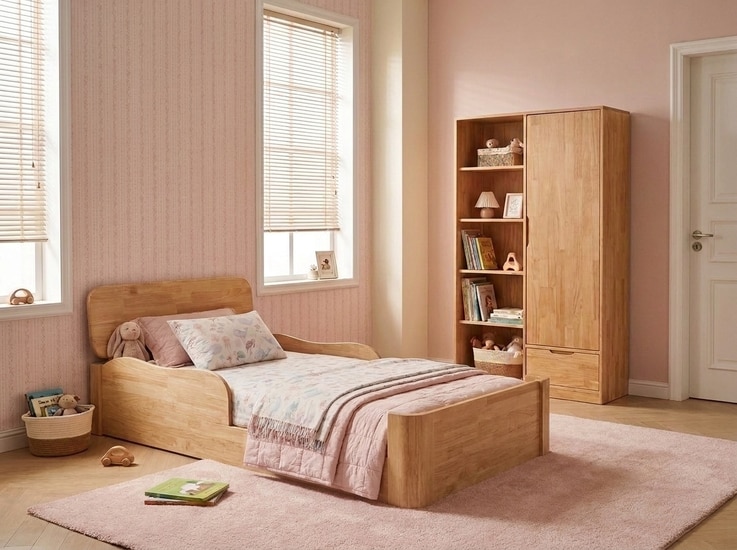
Moving from a crib to a toddler bed gives your child more freedom, but it also changes what parents need to check. Once a child can get out of bed independently, hazards that were previously out of reach can suddenly become accessible.
Before the first night, check more than the bed frame. The mattress fit, guardrails, nearby furniture, windows, cords, and the path your child may take after waking all deserve a closer look.
This guide walks through the key checks, starting with the bed itself and ending with the rest of the room.
What Makes a Toddler Bed Safe?
A toddler bed should do more than give your child a smaller place to sleep. It should provide a stable sleeping surface, support the mattress correctly, and allow your child to get in and out without creating unnecessary fall or entrapment hazards.
In the U.S., toddler beds are covered by a mandatory federal safety standard, 16 C.F.R. Part 1217, which incorporates the applicable version of ASTM F1821 by reference. The regulation addresses mattress support systems, guardrails, openings, side rails, and structural strength to minimize entrapment incidents associated with bed end structures, the space between guardrails and side rails, and the mattress support system.
The CPSC defines a toddler bed as a bed designed to accommodate a full-size crib mattress measuring at least 51⅝ inches long and 27¼ inches wide. It is intended for children at least 15 months old and weighing no more than 50 pounds (22.7 kg).
For parents, that means the most useful safety check is not simply whether a bed looks sturdy. It is whether the bed, mattress, and surrounding setup work together as intended.
A Stable Frame
Toddlers do not always use a bed the way adults do. They may climb, kneel, bounce, or move around while getting comfortable. A frame that feels stable during normal use should also remain secure when a child moves around on it.
Check that the frame sits firmly on the floor and that the major connections are properly tightened. If the bed wobbles, shifts, or makes unusual movement during normal use, stop and check the assembly instructions before allowing your child to sleep on it.
Pay attention to the condition of the frame over time, too. Loose hardware, damaged rails, cracked wood, or bent components can change how the bed performs.
A sturdy frame is especially important because your child may get into and out of bed repeatedly without an adult nearby.
Check for recalls, especially with older or secondhand beds. Before using a used toddler bed, check the model and manufacturer information against current CPSC recalls. A bed that appears structurally sound may still be subject to a safety recall.
Properly Fitted Mattress
The mattress should fit the bed frame it was designed for. This sounds obvious, but it is one of the easiest details to overlook when buying a toddler bed or reusing a mattress from another sleeping setup.
The key issue is the fit.
A mattress that is too small can leave openings between the mattress and the frame. A mattress that is not supported correctly can also move or sit at the wrong height relative to the guardrails.
Before your child sleeps in the bed, place the mattress inside the frame and check the edges carefully. It should sit securely in the intended position without obvious gaps or movement.
If a toddler bed is sold as a frame only, do not assume that any mattress of a similar size will work. Check the manufacturer's specifications for the intended mattress dimensions and support system.
How to Check Mattress Fit
Once the mattress is in place, inspect the entire perimeter.
The mattress should sit securely within the frame without obvious spaces between the mattress and the surrounding bed structure. Pay particular attention to the areas near guardrails and the ends of the bed.
This matters because gaps are not simply a cosmetic issue. The federal toddler bed standard specifically addresses openings and the spaces between structural components because a child's head or neck can become trapped in certain openings.
Do not try to solve a gap by adding blankets, cushions, foam, or other loose materials around the mattress. If the mattress does not fit as intended, check the manufacturer's specifications or contact the manufacturer rather than improvising a solution.
Check the Mattress Support
The mattress should also be supported by the bed's intended support system.
Before your child uses the bed, check that the support components are correctly installed and securely attached. Look underneath the mattress if the design allows you to do so, and make sure the support surface does not shift when the mattress is used normally.
CPSC's toddler bed requirements specifically address mattress support system integrity, attachment, and openings.
This is one reason assembly instructions are worth keeping. If you later need to tighten hardware or replace a component, the original instructions can help you identify the correct parts and installation method.
Appropriate Guardrails
Guardrails are another important part of a toddler bed's design. Young children can move significantly during sleep, and a low rail can help reduce the chance of rolling out of bed.
However, a guardrail should not simply be judged by how high it looks. Its relationship with the mattress and the rest of the bed matters.
Under the CPSC standard, the upper edge of the guardrail must be at least 5 inches above the manufacturer's recommended sleeping surface. The standard also includes provisions to reduce entrapment hazards by testing for hazardous openings in areas such as the mattress support system, guardrails, and end structures.
Before using the bed, check that the guardrail is firmly attached and that the mattress is positioned as intended relative to the rail. Also inspect the spaces around the rail for openings that could allow a child's head or body to become trapped.
--altImgStart--{"link":"https://s3.springbeetle.com/prod-us2-bucket/toddler-bed-guardrail-gap-comparison_20260822_ifcxJgw4.png","alt":"Toddler bed guardrail gap comparison showing a close-fitting rail and a wider opening."}--altImgEnd--
Avoid modifying the guardrail or adding homemade extensions unless the manufacturer specifically provides instructions for doing so. Changes to the original design can affect how the bed performs and may introduce gaps or other hazards.
The goal is not to create a completely enclosed sleeping space. A toddler bed is designed to give a child easier access to the bed while providing appropriate protection against falls and other foreseeable hazards.
A properly assembled toddler bed with a correctly fitted mattress and appropriate guardrails can help reduce common fall and entrapment hazards. But those features only address the bed itself. Once your child can climb out independently, the mattress and frame are only the beginning of the safety check.
Are Toddler Bed Rails Actually Necessary?
For many toddler beds, guardrails are an important part of the design because they help reduce the likelihood of a child rolling out of bed. But their safety depends on how they are positioned and attached, not simply on whether a rail is present.
Nationwide Children's recommends using guardrails that fit against both the mattress and frame so that gaps are not created.
What a Good Guardrail Should Do
A guardrail should provide a barrier along the open side of the sleeping surface while still allowing the child to get into and out of bed.
The goal is not to surround the child completely. Toddler beds are designed for independent access, so the bed needs to balance fall protection with an opening that allows a child to enter and leave safely.
When checking a guardrail, look for three basic things:
- It is securely attached. The rail should not wobble, detach, or move unexpectedly during normal use.
- It is positioned correctly. Follow the manufacturer's instructions for where the rail should sit relative to the mattress.
- It does not create hazardous openings. Check the spaces around and underneath the rail rather than looking only at the rail itself.
What to Check for Gaps
The most important thing to inspect is not just whether the guardrail is present, but whether the assembled bed creates an unintended space between the rail, mattress, and frame.
Run your eyes along the full length of the guardrail and check both ends. Make sure the mattress is positioned correctly and that the rail has not shifted away from the frame.
Older or modified beds deserve extra attention. Hardware can loosen with repeated use, and replacement mattresses or aftermarket rails may not interact with the original bed in the same way as the components specified by the manufacturer.
CPSC has previously documented toddler bed incidents involving spaces between guardrails and mattresses that could allow a child to become entrapped. These hazards are one reason the federal standard addresses mattress retention, guardrails, and openings together rather than treating them as separate features.
Be Careful With Aftermarket Toddler Bed Rails
Adding a rail to a bed that was not designed for it may seem like an easy safety upgrade, but compatibility matters.
A rail that fits one bed does not necessarily fit another. Its attachment method, height, position, and relationship with the mattress can all affect whether it creates a safe or unsafe setup.
If you need an additional rail, first check whether the bed manufacturer approves that type of accessory. Follow the installation instructions exactly, and do not modify the rail or bed frame to make the pieces fit.
There is also an important distinction between a toddler bed with integrated guardrails and a portable bed rail added to an adult bed. These are different products with different safety requirements. Children's portable bed rails are separately regulated under 16 C.F.R. Part 1224 and are intended to help prevent children from falling out of adult beds. They are not designed to be used with toddler beds and should not be used as a substitute for the guardrails that come with the bed.
Use the bed, mattress, and approved components according to the manufacturer's instructions.
Where Should You Put a Toddler Bed?
Choosing a safe toddler bed is only part of the setup. Where you place it can also affect how easily your child can reach windows, cords, furniture, and other objects in the room.
Once a child can get out of bed independently, think about the entire area around the bed. A setup that worked when your child was sleeping inside a crib may need to change when they can walk around the room at night.
--altImgStart--{"link":"https://s3.springbeetle.com/prod-us2-bucket/toddler-bed-safety-guide-bedroom_20260822_DJK8mER7.png","alt":"Toddler bed in a child-safe bedroom prepared for the first night."}--altImgEnd--
Keep the Bed Away From Windows
Avoid placing the bed directly next to a window or in a position where your child can easily reach the window from the mattress.
A toddler who can climb onto the bed can also use it as a step toward a windowsill. Window openings, screens, and nearby furniture can create additional risks when a young child has more freedom to move around.
Window covering cords also deserve attention. Keep blind and curtain cords out of your child's reach, and follow current child-safety guidance for securing window coverings. The CPSC identifies accessible window-covering cords as a strangulation hazard for young children.
If possible, place the bed on a wall away from windows and window-covering cords. CPSC recommends moving beds and other furniture away from windows and window-covering cords, preferably to another wall.
Keep Cords Out of Reach
Look beyond window-covering cords.
Night-lights, lamps, monitors, chargers, fans, and other devices can all introduce cords into the sleeping area. A cord that was previously out of reach may become accessible once your child can stand on the floor and move around independently.
Keep electrical cords away from the bed and avoid running them where a child could pull on them, wrap them around themselves, or use them to reach an appliance.
If you use a baby monitor, night-light, or white-noise machine, consider both the location of the device and the route of its cord. Keep cords completely out of your child's reach, especially around the bed and other climbing areas.
Secure Nearby Furniture
A toddler bed should not be positioned next to furniture that a child could climb or pull over.
Dressers, bookcases, shelving units, and other tall furniture should be properly anchored to the wall. This becomes particularly important when a child is no longer contained within a crib and can move around the room independently.
The CPSC recommends anchoring furniture such as dressers, bookcases, and televisions to prevent tip-over incidents involving children.
Also look at what is stored on nearby furniture. Toys, books, lamps, and other objects may encourage a child to climb or reach. If an item is attractive enough for your toddler to climb toward it, assume they may eventually try.
Check the Space Around the Bed
Leave enough clear floor space around the bed for your child to get in and out without immediately encountering furniture or other obstacles.
This does not mean every toddler bedroom needs a large amount of empty floor space. The goal is to create a predictable path rather than placing the bed in a crowded corner surrounded by hard edges.
Pay particular attention to:
- The side where your child gets into and out of bed
- The space between the bed and nearby furniture
- The path toward the bedroom door
- Any route your child may take to reach a bathroom or a parent's room
- Areas where toys or other objects tend to accumulate
A clear path also makes nighttime supervision easier. If your child gets out of bed, you should be able to see and reach them without navigating around unnecessary obstacles.
Toddler-Proof the Room, Not Just the Bed
The biggest change after moving from a crib to a toddler bed is freedom of movement.
A crib creates a physical boundary around the child. A toddler bed does not. Once your child wakes up, they can walk across the room, open a door, climb onto furniture, or reach objects that were previously inaccessible.
For that reason, childproofing should extend beyond the immediate sleeping area.
Look at the Room From Your Toddler's Height
One useful way to check the room is to physically lower yourself to your child's eye level.
Look around the room and ask:
What can my child reach from the floor?
Then ask:
What could they reach if they stood on the bed?
--altImgStart--{"link":"https://s3.springbeetle.com/prod-us2-bucket/toddler-height-bedroom-safety-check_20260822_4cNRrtLC.png","alt":"Toddler-height view of potential hazards around a toddler bed."}--altImgEnd--
This second question is particularly important. A window latch, shelf, lamp, picture frame, or cord may be outside your child's reach when they are standing on the floor but accessible from the mattress.
You do not need to remove everything from the bedroom. Instead, identify objects that could become a climbing aid, fall hazard, strangulation hazard, or small-object hazard.
Secure Furniture and Wall-Mounted Items
Anchor furniture that could tip if climbed on or pulled.
Check dressers, bookcases, storage units, and televisions. If a piece of furniture has drawers, consider whether your child could use the open drawers as steps.
Wall-mounted objects should also be securely installed. Heavy mirrors, shelves, and other items should not be positioned where they could fall into the sleeping area.
Keep Small Objects Out of the Sleeping Area
Toddlers are naturally curious and may explore objects by putting them in their mouths.
Before bedtime, check the floor and area around the bed for small toys, loose parts, batteries, coins, or other objects that could pose a choking hazard.
The same principle applies to toys attached to the bed. Avoid adding loose accessories simply to make the bed look more inviting. A simple sleeping environment is often easier to keep safe and organized.
Consider What Happens After the Lights Go Out
A bedroom can look safe during the day and feel very different at night.
Your child may wake up when the room is dark, walk around without an adult, or try to find you. Think through what they are likely to do rather than checking only the area immediately around the mattress.
If your child is likely to leave the room, make sure the route is safe as well. Check stairs, doors, hallways, and other areas they could reach during the night.
The transition to a toddler bed is therefore also a transition to greater nighttime independence. The room should be prepared for that independence.
What to Do When Your Toddler Keeps Getting Out of Bed
Getting out of bed repeatedly is common during the transition. Your child may be testing their new freedom, looking for a parent, or simply discovering that they can leave the bed whenever they want.
The important thing from a safety perspective is to make sure the room remains safe even when your child does not stay in bed.
Keep the Path Safe
If your child regularly gets out of bed, check the route they take.
Remove obstacles from the floor and make sure they cannot easily reach cords, windows, unsecured furniture, or other hazards along the way.
If they walk to your room at night, consider the entire path rather than focusing only on the bedroom.
Keep the Nighttime Environment Predictable
A familiar bedtime routine can help your child understand that moving to a toddler bed does not mean that the rules around bedtime have disappeared.
Keep the routine consistent and make expectations simple. For example, your child can understand that bedtime means staying in the bedroom and getting back into bed after using the bathroom or getting a drink.
Avoid Turning Every Bed Exit Into a New Activity
Keep nighttime interactions calm and brief when possible, then return to the normal bedtime routine. If repeated waking continues or you have concerns about your child's sleep, discuss the situation with your pediatrician.
Toddler Bed Safety Checklist: What to Check Before the First Night
Before your child sleeps in the new bed, take a few minutes to check the entire setup.
--altImgStart--{"link":"https://s3.springbeetle.com/prod-us2-bucket/toddler-bed-safety-checklist_20260822_C6wmANVp.png","alt":"Toddler bed safety checklist for checking the bed and bedroom before the first night."}--altImgEnd--
Check the Bed
- Make sure the frame is stable and does not wobble during normal use.
- Confirm that all required hardware is installed and tightened according to the manufacturer's instructions.
- Use only a mattress that meets the bed manufacturer's size and support requirements.
- Check the entire mattress perimeter for unintended gaps.
- Make sure the mattress support system is correctly installed and secure.
- Check that guardrails are firmly attached and positioned as intended.
- Do not add, remove, or modify structural components unless the manufacturer specifically allows it.
Check the Bedroom
- Place the bed away from windows and window-covering cords where possible.
- Keep blind and curtain cords completely out of your child's reach.
- Anchor dressers, bookcases, TVs, and other furniture that could tip over.
- Keep electrical and baby-monitor cords away from the sleeping area.
- Remove small objects that could present a choking hazard.
- Keep furniture and other potential climbing aids away from windows.
- Check lamps, monitors, and other devices for accessible cords.
- Keep the floor around the bed reasonably clear.
- Check the route your child may take if they get out of bed at night.
Check the First Night
Before turning out the lights, think through what your child can do without your help.
Can they get into bed safely? Can they get out without falling? Can they reach a window, cord, shelf, or piece of furniture from the bed? What happens if they wake up and walk around the room?
These questions are often more useful than simply asking whether the bed itself is safe.
Frequently Asked Questions About Toddler Bed Safety
1. What age is a toddler bed for?
Under the CPSC definition, toddler beds are intended for children at least 15 months old and weighing no more than 50 pounds (22.7 kg). Parents should also follow the age, weight, and use instructions provided for the specific bed.
2. Can you use any mattress in a toddler bed?
No. The mattress should match the size and requirements specified for the bed. If you are reusing a crib mattress, check the toddler bed manufacturer's instructions rather than assuming that every crib mattress will fit correctly.
3. Does a toddler bed come with a mattress?
Not always. Some toddler beds are sold with a mattress, while others are sold as a frame only. If you are shopping for a toddler bed with mattress, check exactly what is included and confirm that the mattress is intended for that specific bed.
4. How much space should be around a toddler bed?
There is no single clearance measurement that applies to every bedroom layout. The more important goal is to leave a clear path for your child to get in and out of bed and to avoid positioning the bed where it provides easy access to windows, cords, unstable furniture, or other hazards.
5. Should a toddler bed be against the wall?
The answer depends on the bed's design and the manufacturer's instructions. Do not assume that pushing a bed against a wall automatically makes it safer. The mattress, guardrails, frame, and wall relationship should be considered together so that the setup does not create an unintended gap.
6. What should I do if my toddler keeps getting out of bed?
First, make sure the bedroom remains safe when your child is awake and moving around independently. Keep nighttime interactions calm and consistent, and check the room for hazards along the path your child takes when leaving the bed.
7. Is a floor bed safer than a toddler bed?
A floor bed may reduce the risk associated with falling from a raised surface, but it does not automatically make the entire sleep environment safer. The room still needs to be childproofed, and the sleeping surface should be appropriate for the child's age and the manufacturer's instructions.
A Safe Toddler Bed Is Part of a Safe Sleep Space
Moving to a toddler bed is more than a change in sleeping furniture. It gives your child new freedom to move around the room, which changes the way the entire sleeping space needs to be prepared.
Before the first night, check the frame, mattress, guardrails, and surrounding floor space. Then look at the room from your child's perspective and consider what they could reach from the bed or after getting out of it.
The goal is not to create a perfectly controlled room. It is to create a sleeping environment where your child can gain independence without being exposed to unnecessary hazards.
Sources
- U.S. Consumer Product Safety Commission (CPSC). Toddler Beds – Business Guidance.
- U.S. Consumer Product Safety Commission (CPSC). Children's Portable Bed Rails – FAQ.
- U.S. Consumer Product Safety Commission (CPSC). Window Covering Cords – Go Cordless.
- U.S. Consumer Product Safety Commission (CPSC). Childproofing Your Home – Safety Devices.
- Nationwide Children's Hospital. Toddler Bed Safety.