
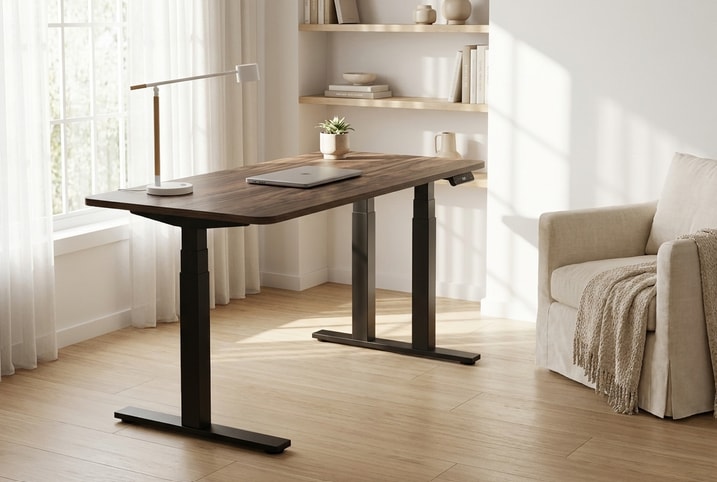
A standing desk seems like a simple purchase. You choose a size, compare features, check reviews, and decide which model fits your budget.
But many buyers discover an unexpected problem after setting up their new workspace: the desk itself is not the issue. The problem is that they chose based on specifications instead of how they actually work.
A standing desk is more than a height-adjustable surface. It becomes the foundation of your home office, affecting everything from monitor placement and available space to daily comfort and long-term flexibility.
If you are searching for the best standing desk for a home office, the most important step is understanding what matters before you buy.
Quick answer: The right choice is one that fits your workspace, equipment, and daily routine. Start with how you work, not the product specifications.
Before comparing options, consider these seven factors.
1. Desk Size Should Match Your Space, Not Just Your Ideal Setup
One of the most common mistakes people make is choosing a desk size based on their ideal setup rather than their actual room.
Online photos often show large, clean workspaces with plenty of open space around the desk. In reality, many home offices are created in bedrooms, apartment corners, shared rooms, or smaller areas where every inch matters.
A larger desktop is not always better.
A desk that takes up too much space can make a room feel crowded and limit movement. On the other hand, choosing a surface that is too small may leave you with little room for essential equipment.
Before choosing a desk size, consider:
- The available wall or floor space
- Where your chair will sit when the desk is lowered
- Whether you need room to move around comfortably
- What equipment will remain on the desktop
- Whether the workspace has other functions
A small standing desk can be an excellent choice for compact spaces, but only if it provides enough room for the way you work.
Width Is Not the Only Measurement That Matters
Many buyers compare desks by width because it is the easiest number to understand.
However, desktop depth often has a greater impact on comfort than expected.
A shallow desk may limit how far you can position your monitor, leaving less room for keyboards, notebooks, or other daily essentials. A deeper surface can provide more flexibility, especially for users with larger displays or more complex setups.
The right desk size is not about choosing the biggest option available. It is about finding a balance between available space and everyday usability.
2. Minimum Height Matters More Than Maximum Height
When shopping for an adjustable height standing desk, many buyers focus on one specification: how high can it go?
This makes sense, especially for taller users or shared workspaces where different people may need different height settings.
However, maximum height is only part of the story.
For many people, the minimum height is equally important.
A desk that does not lower enough can create an uncomfortable sitting position. Users may need to raise their shoulders, adjust their chair height, or change their wrist position just to reach the keyboard comfortably.
Over time, small adjustments like these can affect how natural the workstation feels.
Why the Full Adjustment Range Matters
A good height-adjustable desk should support both sitting and standing positions.
That means the entire adjustment range matters, not just the highest setting.
The ideal height depends on factors such as:
- Your body dimensions
- Chair height
- Monitor position
- Keyboard placement
- Personal working habits
Workplace ergonomics guidance from the Occupational Safety and Health Administration (OSHA) emphasizes maintaining neutral body positions and reducing awkward postures during computer work.
A desk with a wider adjustment range can accommodate more users and working positions, especially in shared home offices where different people may use the same workstation.
--altImgStart--{"link":"https://s3.springbeetle.com/prod-us2-bucket/standing-desk-minimum-height-ergonomics_20260710_yaa45ySD.png","alt":"Infographic comparing correct vs incorrect sitting posture on an adjustable height standing desk based on OSHA guidelines."}--altImgEnd--
3. Your Work Style Should Determine Your Workspace Requirements
A common buying mistake is choosing a desk first and thinking about the setup later.
The better approach is the opposite: start with how you work.
A person who uses only a laptop has very different workspace requirements from someone who works with multiple monitors, creative equipment, or a large desktop computer.
For example:
- Laptop users: A smaller surface may provide enough room while keeping the workspace compact.
- Dual-monitor users: More desktop depth and stability may become priorities.
- Creative professionals: Additional surface area can be important for tools, documents, or equipment.
The right standing desk for a home office is not necessarily the largest one. It is the one that supports your workflow without creating unnecessary clutter.
Think About How Your Setup May Change
A workspace rarely stays exactly the same.
A laptop setup may eventually become a larger workstation. A simple home office may expand with additional equipment over time.
Before buying, consider whether your desk can support possible changes such as:
- Additional monitors
- Monitor arms
- Larger keyboards
- Charging devices
- Workspace accessories
Planning ahead does not mean buying more desk than you need. It means avoiding a situation where your workspace becomes limiting after only a short time.
4. Not Every Electric Standing Desk Provides the Same Experience
Many buyers assume that most electric standing desks feel similar because they share comparable features.
They often compare:
- Adjustment speed
- Height range
- Noise level
- Preset controls
These specifications are useful, but they do not always tell the complete story.
The differences usually become noticeable through everyday use.
A desk may look impressive on a product page but feel different when you adjust it multiple times throughout the day. Smooth movement, reasonable noise levels, and consistent performance can have a greater impact on daily satisfaction than a single specification.
This is especially important for people who frequently switch between sitting and standing.
Look Beyond the Numbers
Specifications help narrow down choices, but they should not be the only deciding factor.
A desk that adjusts consistently and predictably tends to provide a better experience over time than one that feels inconsistent during daily use.
When evaluating an electric standing desk, consider how the entire system works together rather than focusing on one impressive number.
The goal is not to choose based on one impressive specification. It is to find a desk that fits your daily workflow and performs reliably over time.
5. Stability Matters More Than Many Buyers Expect
Stability is easy to overlook because many desks may feel similar during a quick test. However, differences often become more noticeable when the desk is fully raised or supporting heavier equipment.
A stable desk creates a more consistent working experience.
A less stable setup may become distracting when:
- Typing quickly
- Using multiple monitors
- Adjusting the desk height frequently
- Working with precision equipment
--altImgStart--{"link":"https://s3.springbeetle.com/prod-us2-bucket/standing-desk-stability-engineering_20260710_N20RGDKV.png","alt":"Diagram showing the difference between unstable thin steel desk columns and heavy-duty premium steel desk legs."}--altImgEnd--
A desk designed for your intended use will usually provide a better experience than one chosen only because it has the largest advertised capacity. Of course, choosing the frame is just the first step. Avoiding common standing desk setup errors ensures your workplace functions flawlessly from day one.
Weight Capacity Is Only Part of the Picture
Weight capacity is an important specification, but it should not be treated as the only measurement of quality.
A desk's stability can also depend on:
- Frame construction
- Column design
- Desktop size
- Equipment placement
- Maximum height position
- Overall frame weight
For example, a larger desktop with heavy equipment placed farther from the frame may create different stability requirements than a compact laptop setup.
If it is difficult to judge stability before buying, one overlooked specification can provide additional context: frame weight.
In many cases, a heavier frame reflects the use of more steel in key structural components, such as the lifting columns, crossbeam, and support brackets. While frame weight alone does not guarantee better performance, it often indicates a structure designed to resist flex and wobble more effectively, especially at taller working heights.
This is one reason experienced buyers often look beyond appearance when comparing standing desks. Two desks may look nearly identical online, but differences in frame construction and material can significantly affect how stable they feel in daily use.
A desk designed for your intended setup will usually provide a better experience than one chosen only because it advertises the highest weight capacity.
6. Extra Features Should Come After the Basics
Standing desks often come with additional features designed to make the workspace more convenient.
These may include:
- Drawers
- Charging options
- Storage accessories
- Cable solutions
- Additional controls
These features can be useful, but they should come after the fundamentals. A desk with more extras is not always the better choice if it does not fit your space, body, or workflow.
Before considering accessories, prioritize:
- Does the desk fit your available space?
- Does the height range work for your body?
- Does the surface support your equipment?
- Does the frame meet your stability needs?
Only after those questions are answered should additional features influence your decision.
Choose Accessories That Support Your Workflow
A standing desk with drawers can be useful for people who regularly work with notebooks, documents, or small accessories.
An integrated storage system can also help keep frequently used items organized and within reach, reducing desktop clutter without requiring additional furniture.
This can be especially helpful in shared home offices where keeping the desktop clear helps the space serve multiple purposes.
However, built-in storage is not necessary for everyone. Users who prefer a minimalist workspace or already have nearby storage may find other features more valuable.
Likewise, locking casters can be a worthwhile addition if you expect to move your desk regularly. They make it easier to reposition a heavy desk for cleaning, rearranging a room, or adapting a shared workspace, while locking securely during everyday use.
--altImgStart--{"link":"https://s3.springbeetle.com/prod-us2-bucket/standing-desk-stability-with-locking-casters_20260710_vWKbx2hg.png","alt":"Electric standing desk with locking casters installed to improve mobility while maintaining stability during everyday use."}--altImgEnd--
The most useful accessories are the ones that solve problems you actually have. A desk with fewer features but the right upgrades for your space may provide more value over time.
7. Choose a Desk That Can Adapt Over Time
A standing desk is not usually a short-term purchase.
Unlike smaller office accessories, it often becomes the foundation of a workspace for several years.
That means the right choice should consider not only your current setup but also how your needs may change.
Before buying, ask:
- Will this desk still work if my equipment changes?
- Could another person use it comfortably?
- Would it fit if my workspace moves to another room?
- Does it provide enough flexibility for future needs?
These questions help prevent a common problem: choosing a desk that works perfectly today but becomes limiting later.
A Good Desk Should Adapt With You
Work habits change.
Some people move from occasional remote work to full-time home offices. Others add equipment as their projects become more complex.
A flexible desk allows your workspace to grow without requiring a complete replacement. The goal is not to predict every future change, but to leave enough room for your workspace to evolve.
A desk that can accommodate changes in equipment, room layout, and working habits is more likely to remain useful over time.
Before You Buy: A Quick Standing Desk Checklist
Before making a final decision, review these questions:
☐ Have I measured the available space in my room?
☐ Does the height range work for both sitting and standing?
☐ Is the desktop large enough for my current equipment?
☐ Will the desk support the type of equipment I use?
☐ Does the desk fit the way I plan to use it every day?
☐ Have I considered how my workspace may change in the future?
☐ Am I choosing useful features rather than paying for features I may not use?
A standing desk is easier to choose when you focus on your actual needs instead of trying to find a universal "best" option.
Final Thoughts
Choosing a standing desk is not simply about finding the model with the most features or the highest specifications. The right choice depends on how well the desk fits your room, your work habits, and your long-term plans.
If you are searching for the best standing desk for a home office, start by evaluating your own workspace before comparing products. Consider the size you need, the height range that feels comfortable, the equipment you use, and the flexibility you may need in the future.
A well-chosen adjustable height standing desk should feel like a natural extension of your workspace. It should support the way you work today while giving you enough flexibility for tomorrow.
Frequently Asked Questions
1. What is a standing desk?
A standing desk is a workstation that allows users to work while sitting or standing by adjusting the desktop height. Many modern versions use electric motors, while others use manual adjustment mechanisms.
2. What is the best standing desk for a home office?
The best standing desk depends on your workspace size, equipment, height requirements, and daily routine. A desk that matches your needs is usually a better choice than choosing one based only on size, price, or features.
3. How do I choose an adjustable height standing desk?
Start by checking four things: height range, desktop size, stability, and how well the desk fits your working habits. These factors usually matter more than additional features.
4. Are electric standing desks worth it?
An electric standing desk can be a practical choice for users who frequently change positions throughout the day. Automatic height adjustment makes transitions easier and more convenient compared with most manual alternatives.
5. Can a standing desk be adjusted manually?
Yes. Some standing desks use manual adjustment mechanisms instead of electric motors. Manual models can work well for users who only change heights occasionally, while electric models are often more convenient for people who switch positions frequently throughout the day.
6. Is a small standing desk enough for working from home?
A small standing desk can work well for compact spaces or simple setups. The key is ensuring that it still provides enough room for the equipment you use every day.
7. Do standing desks need drawers?
Not necessarily. Some users benefit from built-in storage, while others prefer a cleaner desktop with separate storage solutions. The best choice depends on how you organize your workspace.
8. How long should a standing desk last?
A quality standing desk is designed for long-term use, but lifespan depends on factors such as build quality, frequency of adjustment, and daily workload.
Sources
- Occupational Safety and Health Administration (OSHA). Computer Workstations: Good Working Positions. Available at: https://www.osha.gov/etools/computer-workstations/positions