
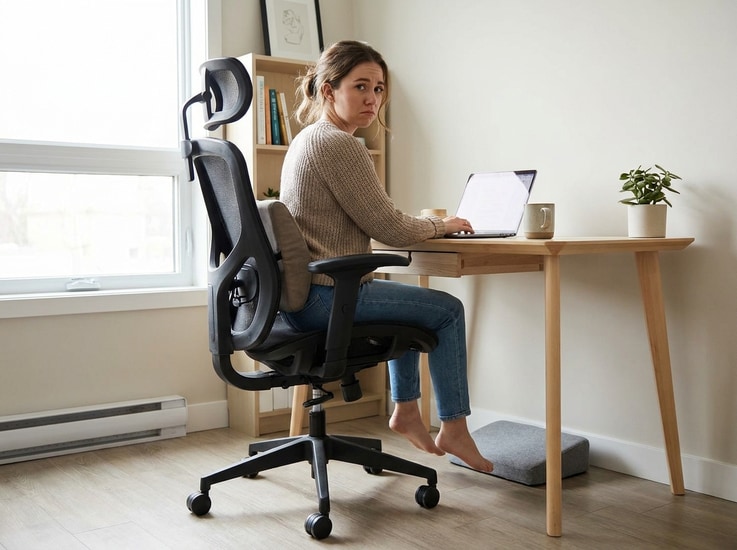
You are 5'2" (157 cm). You have read dozens of reviews. You finally bought a highly rated ergonomic chair. Yet something still feels off.
The lumbar support pushes against your upper back instead of your lower back. The seat feels like it was made for someone with longer legs. Your feet barely touch the floor, and by mid-afternoon, the back of your knees feel sore.
This is not because you bought a bad chair. It is because most ergonomic chairs are designed for someone of average height, roughly 5'8" to 5'10". If you are under 5'4" (162 cm), you are often trying to fit into a chair that was never built for your proportions.
The good news is that a few small adjustments, and the right chair, can completely change how your body feels at the end of the workday.
Here is what actually matters if you are shopping for the best ergonomic office chair and have a smaller frame.
Why Most Ergonomic Chairs Feel Wrong for Shorter People
Imagine sitting down in an ergonomic office chair that everyone online says is comfortable. The lumbar curve hits somewhere around your mid-back. Your feet hang slightly because the seat does not go low enough. To reach the backrest, you slide forward, but then your knees press against the front edge of the seat.
This is not a fitting problem. It is a size problem.
Many chairs are built around average body dimensions. For someone under about 5'4", the seat depth alone can make or break the chair. If it is too deep, you cannot use the backrest properly. If the lumbar support is too high, it pushes your spine into an unnatural curve instead of supporting it. If your feet do not rest flat on the floor, your thighs take extra pressure.
The result is not just discomfort. It is fatigue, tension, and a low-grade ache that builds over the course of a long workday.
What Shorter Users Should Look for in an Ergonomic Chair
You do not need a chair with twenty adjustment levers. You need an ergonomic chair where the critical adjustments actually work for your body size.
Seat Height
Your feet should rest flat on the floor. Your knees should stay close to a right angle. According to common ergonomic guidelines, your knees should remain roughly level with or slightly below your hips when seated. If the lowest seat height still leaves your feet dangling, your thighs will carry unnecessary pressure. Over time, that pressure can affect circulation and make long work sessions feel more tiring than they should be.
Seat Depth
This is often the most overlooked adjustment for shorter users. When you sit all the way back against the backrest, you should be able to fit two or three fingers between the front edge of the seat and the back of your knees. If the seat edge presses against the back of your knees, the seat is too deep. If there is an unusually large gap, the seat may be too shallow and provide less support for your thighs.
--altImgStart--{"link":"https://s3.springbeetle.top/prod-common-bucket/commodity/item/1028_file_ergonomic-chair-seat-depth-short-users-comparison_20260616_ZtkoVoA0.png","alt":"Comparison showing correct and incorrect seat depth for shorter ergonomic chair users."}--altImgEnd--
Lumbar Support
Lumbar support only works when it sits exactly where your lower back naturally curves. For many shorter users, fixed lumbar support lands too high. Instead of supporting the natural inward curve of the lower back, it pushes against the area just below the shoulder blades. Adjustable lumbar support is not a luxury. It is a necessity.
Armrests
Armrests that are too wide or too high force your shoulders into a shrugged position. Over a full workday, that tension often travels into the neck and upper back. Look for armrests that adjust close enough to your body and low enough to let your shoulders remain relaxed while typing.
--altImgStart--{"link":"https://s3.springbeetle.top/prod-common-bucket/commodity/item/1028_file_ergonomic-chair-armrest-width-shoulder-support_20260616_FFuZ1N8T.png","alt":"Ergonomic chair armrest width comparison showing shoulder strain versus relaxed shoulder posture."}--altImgEnd--
Armrests that sit too far apart can force the shoulders into a strained position, even when seat height and lumbar support are properly adjusted.
Headrest
If a chair has a headrest, it should not push your head forward. For shorter users, a poorly positioned headrest can create more neck strain than it solves. Height and angle adjustments become especially important if you frequently lean back while working.
The One Measurement Most Reviews Ignore: Shoulder Width
Most ergonomic chair guides focus on height. Few discuss shoulder width.
This matters because many shorter users also have narrower shoulders. A chair may technically fit your height range but still feel uncomfortable if the armrests sit too far apart. When armrests are positioned too wide, your elbows naturally drift outward. That may not seem like a major issue at first, but over several hours it can create tension in the shoulders, neck, and upper back.
This is one reason why highly adjustable armrests often matter more than extra recline angles or premium materials. For many petite users, shoulder fit can have just as much impact on comfort as seat height. This is also why some chairs that receive excellent reviews from taller users still feel uncomfortable for shorter users. The issue is not quality. It is scale.
How We Chose These Chairs
Not every ergonomic office chair works well for shorter users. For this guide, we focused on five factors that tend to have the biggest impact on comfort for people under 5'4":
- Adjustable seat depth: Ensuring your thighs are supported without hitting the back of your knees.
- Low minimum seat height: Allowing feet to plant firmly on the ground to relieve thigh pressure.
- Adjustable lumbar support: Vertically customizable to target the lower back curve accurately.
- Narrower armrest accommodation: Preventing shoulder fatigue caused by wide-set arm positions.
- Overall footprint: Ensuring compatibility with smaller home office spaces.
We also considered overall adjustability, long-term comfort, build quality, and how well each chair accommodates petite body proportions without requiring aftermarket accessories such as footrests or seat cushions.
What If You Also Work in a Small Space?
Many home offices are located in spare bedrooms, apartments, or shared living spaces where floor space is limited.
--altImgStart--{"link":"https://s3.springbeetle.top/prod-common-bucket/commodity/item/1028_file_compact-home-office-ergonomic-chair_20260616_O0lvI9OE.png","alt":"Compact home office with an ergonomic chair designed for small spaces."}--altImgEnd--
Many modern apartments require ergonomic furniture that balances comfort with a smaller footprint.
Here are a few things to consider if space is tight:
- Base footprint: A chair with a smaller wheelbase is easier to move around and less likely to feel cramped in a narrow room.
- Armrest clearance: Look for armrests that can drop low enough to slide under your desk when not in use. This alone can make a small room feel much more open.
- Visual weight: Chairs with mesh backs and slim profiles tend to look less bulky than thickly padded executive chairs. In a small space, that visual difference matters.
- Tuck-under capability: A chair that fits completely under your desk when pushed in can free up walking space in a shared room.
Best Ergonomic Office Chairs for Short People
Before diving into the details, here is a quick overview of our recommendations for 2026.
| Chair Model | Best For | Key Strength |
| FlexiSpot ErgoStretch | Best Overall for Short Users | Adjustable seat depth, low seat height, and adaptive support |
| Herman Miller Aeron (Size A) | Best Premium Alternative | Designed specifically for smaller body types |
FlexiSpot ErgoStretch
The FlexiSpot ErgoStretch is often associated with stretching, but it is also one of the more accommodating ergonomic chairs for shorter users. Its 15.5-inch minimum seat height and adjustable 16.5-inch seat depth make it easier to achieve proper leg positioning, while inward-rotating armrests help accommodate narrower shoulder widths despite the chair's relatively wide frame.
Combined with adaptive lumbar support and extensive adjustability, the ErgoStretch offers a level of fit that many standard ergonomic chairs struggle to provide for users under 5'4".
--altImgStart--{"link":"https://s3.springbeetle.top/prod-common-bucket/commodity/item/1028_file_ergostretch-adjustable-seat-depth-short-users_20260616_spVEwt2h.png","alt":"FlexiSpot ErgoStretch ergonomic chair with adjustable seat depth designed for shorter users."}--altImgEnd--
Herman Miller Aeron (Size A)
For users willing to invest in a premium ergonomic chair, the Herman Miller Aeron Size A remains one of the most recognized options specifically designed for smaller body types.
Unlike most ergonomic chairs that scale around average-height users, the Size A version was intentionally built with petite users in mind. Its compact dimensions allow many shorter users to achieve proper seat height and arm positioning without extensive adjustments.
However, the Aeron's seat depth is fixed, which limits flexibility compared with chairs that offer adjustable seat pans. It is also significantly more expensive than most alternatives in this category.
How to Tell if an Ergonomic Chair Actually Fits You
After adjusting your chair, sit in it for several minutes and run through this quick checklist:
- Do your feet rest flat on the floor?
- Can you sit fully against the backrest?
- Is there a small gap (2-3 fingers) between the seat edge and the back of your knees?
- Does the lumbar support sit directly in the curve of your lower back?
- Can you type with completely relaxed, un-shrugged shoulders?
- If there is a headrest, does it support your neck without pushing your head forward?
If you answered yes to most of these questions, you are likely close to an ergonomic fit. If not, no amount of premium materials or extra features will fully compensate for poor sizing.
--altImgStart--{"link":"https://s3.springbeetle.top/prod-common-bucket/commodity/item/1028_file_ergonomic-chair-features-shorter-user-guide_20260616_xpXlOCNc.png","alt":"Guide comparing poor fit and proper fit ergonomic chair features for shorter users."}--altImgEnd--
A properly fitted ergonomic chair should support your feet, knees, lower back, and shoulders without forcing your body into awkward positions.
Frequently Asked Questions
1. What height is considered short for an ergonomic office chair?
Most ergonomic chair guides consider users under about 5'4" (162 cm) to benefit from chairs with enhanced seat height cylinders and shorter seat depth adjustments.
2. Is seat depth really important for shorter people?
Yes. A seat that is too deep prevents you from sitting fully against the backrest, making the lumbar support significantly less effective and causing you to slouch forward.
3. Can a tall-back ergonomic chair work for a short person?
It can, provided the chair offers sufficient adjustment ranges for the headrest, lumbar support, and seat depth. Without those micro-adjustments, a tall backrest will misalign and support the wrong areas of your torso.
4. Should short people use a footrest?
A footrest can help if your current desk setup forces you to lift the chair too high to reach the desktop. However, choosing an ergonomic office chair with a suitable lower adjustment range is always the better long-term solution for healthy leg circulation.
Final Thoughts
The best ergonomic office chair for a shorter person is not necessarily the most expensive model or the chair with the longest feature list. It is the chair that allows your body to maintain a comfortable, supported posture without forcing you to adapt to dimensions that were designed for someone else.
When evaluating ergonomic chairs, prioritize seat height range, seat depth adjustment, lumbar positioning, armrest flexibility, and headrest adjustability.
For many shorter users, finding the right fit can make a meaningful difference in daily comfort, mental focus, and your long-term remote work experience.