
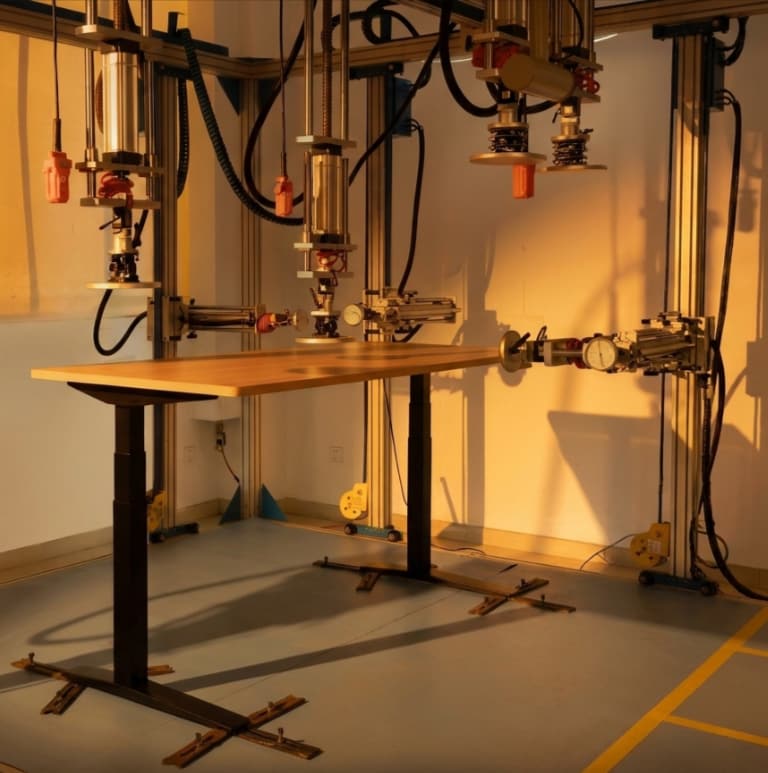
A standing desk doesn't have one job. It has several, and they all need to work together. The frame supports the desktop, the motors lift it, and the control system keeps everything moving in sync. But a desk that performs well under one condition won't necessarily perform the same way under another. What happens when it's raised higher, carries more weight, or has to repeat the same movement thousands of times?
These questions are at the heart of the FlexiSpot E7 Pro Engineering Validation White Paper. Rather than judging a standing desk by individual specifications, the 71-page report examines how its mechanical and electronic systems perform together. Its framework covers 98 test items, including 35 tests conducted according to international standards and 63 supplementary engineering tests, spanning stability, power, safety, precision, durability, and energy efficiency.
A Desk's Real Strength Shows When Conditions Get Tougher
A standing desk is easiest to keep stable when it's lowered, lightly loaded, and left untouched. That's rarely how people use one.
Raise the desktop to standing height, add multiple monitors, or lean against the edge, and the structure faces greater demands. For many users, the first sign of instability isn't the desk visibly rocking. It's a monitor that shakes while typing or a work surface that moves when writing. Several factors can contribute to this, from desk height and frame construction to monitor arms and flooring. For a closer look, see our guide to why standing desks wobble.
To evaluate stability at standing height, the E7 Pro was tested with its feet secured against sliding. At a height of 50.4 inches (1,280 mm), testers applied a 22.5-pound-force (100 N) horizontal push under a specified 44.1-pound (20 kg) load condition, including the tabletop's own weight. The four recorded displacement measurements ranged from 0.07 to 0.10 inches (1.75–2.62 mm), all below the test's 0.14-inch (3.5 mm) acceptance limit.
--altImgStart--{"link":"https://s3.springbeetle.com/prod-us2-bucket/e7-pro-standing-desk-stability-lab-test_20261111_Fi4I1lvh.png","alt":"e7-pro-standing-desk-stability-lab-test.png"}--altImgEnd--
That means the desk moved no more than about one-tenth of an inch under the specified test conditions. It doesn't mean the desktop will never move during use, but it provides a measurable result where a simple claim of being "stable" would not.
The frame's construction helps explain the engineering approach behind that result. The E7 Pro uses overlapping steel lifting columns that continue supporting one another as the desk rises. Together with its C-shaped frame and reinforced feet, these components are designed to resist movement when the legs are extended.
Yet stability is only one part of the challenge. The same structure must support the equipment on the desktop while the motors raise and lower it. This is where weight-capacity specifications can be misleading if viewed in isolation. The E7 Pro white paper distinguishes between a 397-pound (180 kg) dynamic lifting capacity and a 573-pound (260 kg) static holding capacity. The first concerns powered movement; the second concerns supporting a stationary load. They are not interchangeable.
Instead of testing load capacity alone, the report also examined how the desk operated under that weight. Without a load, the E7 Pro lifted at approximately 2 inches per second. Under the full 397-pound test load, it maintained approximately 1.6 inches per second. Operating noise remained below 50 dB in the reported laboratory measurements. For available configurations and current product specifications, visit the FlexiSpot E7 Pro standing desk product page.
--altImgStart--{"link":"https://s3.springbeetle.com/prod-us2-bucket/e7-pro-operating-noise-acoustic-test_20261111_z70vvTss.png","alt":"FlexiSpot E7 Pro standing desk undergoing operating noise testing in an acoustic laboratory."}--altImgEnd--
Taken together, these results address a more meaningful question than simply how much the desk can carry: Can its frame and lifting system continue meeting their performance requirements as the demands increase? But passing those tests with a relatively new desk is only part of the story.
What Happens After Thousands of Lifts?
Consider what a standing desk does over time. Its lifting columns repeatedly extend and retract. The motors work against the weight of the desktop and everything on it. Mechanical components experience repeated loading, while the control system must continue coordinating each movement. This is why endurance testing matters. And it's also why a large cycle count, by itself, can be difficult to interpret.
The E7 Pro white paper documents a full-load endurance test in which the desk completed 15,000 lifting cycles while carrying 397 pounds (180 kg). One cycle represents a complete ascent and descent, with prescribed operating and cooling intervals between movements.
The tested samples completed the required 15,000-cycle milestone without recorded anomalies. During additional testing beyond that target, abnormal noise was recorded in two samples at approximately 15,400 and 15,770 cycles.
A separate test under a lighter 165-pound (75 kg) load completed 40,000 cycles without recorded anomalies. The difference between these results matters. Repeatedly raising nearly 400 pounds creates different demands from lifting 165 pounds. The number of cycles tells you how often the desk moved; the load and operating conditions help explain what the test actually required.
--altImgStart--{"link":"https://s3.springbeetle.com/prod-us2-bucket/e7-pro-lifting-cycle-durability-lab-test_20261111_9fnwRJtY.png","alt":"FlexiSpot E7 Pro lifting cycle durability test equipment in the engineering laboratory."}--altImgEnd--
But one of the white paper's more revealing evaluations went beyond asking whether the desk could still lift. After 14,000 full-load lifting cycles, a tested desk was subjected to another challenge: holding a stationary 573-pound (260 kg) load for 72 hours. The requirement was to limit downward movement to less than 0.04 inches (1 mm). The evaluation passed. This is where the report's system-level approach becomes particularly meaningful.
The question was no longer simply whether the motors could complete repeated lifts, or whether the frame could support a heavy load. It was whether the tested desk could maintain its position under substantial stationary weight after its lifting mechanism had already experienced extensive use. For a consumer, that's a different kind of evidence from a maximum-capacity figure on a product page. It connects performance over time with structural strength and load-holding capability.
These accelerated tests cannot predict exactly how many years a desk will last in every home. What they can show is how the tested system performed after repeated operation under documented conditions.
Reliability Also Means Knowing What the Desk Will Do Next
Strength and endurance are important, but neither makes a standing desk pleasant to use if its movements are unpredictable. Most people don't think about the control system when they press a saved height preset. They simply expect the desk to return to the right position.
The E7 Pro white paper evaluated height-display accuracy against a 0.2-inch (5 mm) tolerance and recorded the relevant tests as passing. It also verified that saved height presets were retained under the specified sleep and power-interruption conditions. Together, these evaluations address an everyday expectation: the desk should respond predictably and remember the settings its user relies on.
That coordination becomes even more important when something interrupts the movement. Imagine lowering your desk without noticing that your chair is still underneath it. The desk needs a way to recognize unexpected resistance and respond. The E7 Pro uses motor-current sensing together with gyroscope information to help detect obstacles and trigger a stop-and-reversal response.
Rather than evaluating the system against only one type of object, the white paper tested several obstacles with different physical characteristics, using the default second-level sensitivity.
| Obstacle | Recorded Reversal Rate |
| Fixed overhead obstacle | 100% |
| Rigid cabinet | 100% |
| Chair armrests | 80% |
| Chair backrest | 80% |
| Empty plastic bottle | 90% |
All five scenarios met their respective test criteria. The differences are as informative as the successful results. A rigid cabinet and a lightweight plastic bottle interact differently with a moving desktop, so detection performance can vary. The report also identifies limitations with extremely soft, flexible, or lightweight objects. Anti-collision protection can help reduce risks, but it doesn't eliminate the need to keep the desk's movement path clear.
The control system's responsibilities also extend beyond active movement. The report includes standby-power and electromagnetic-emissions evaluations. Under a controlled 240 V/50 Hz test, standby consumption measured 0.252 W, although this is not a measurement under U.S. 120 V/60 Hz conditions.
These findings reinforce the broader point: a standing desk's electronic system isn't simply responsible for moving the motors. It also affects accuracy, safety responses, and electrical performance.
What Does All This Look Like in a Home Office?
Engineering tests become more useful when their results can be connected to familiar situations.
--altImgStart--{"link":"https://s3.springbeetle.com/prod-us2-bucket/e7-pro-real-world-home-office-validation_20261111_Wg33vbSc.png","alt":"FlexiSpot E7 Pro real-world home office validation covering desk stability, obstacle protection and desktop durability."}--altImgEnd--
The E7 Pro white paper therefore includes real-world demonstrations involving dual monitors, a laptop, typing, writing, leaning against the desktop, and using a walking treadmill. These scenarios help readers observe the desk in the kinds of situations where stability and coordinated lifting performance matter.
The report also demonstrates obstacle responses using common office furniture and examines the strength and surface durability of a selected, currently sold tabletop. Because the E7 Pro can be paired with different desktop materials, those tabletop findings apply to the tested configuration rather than every available option.
The demonstrations are not substitutes for controlled measurements. Their value is in showing what those measurements relate to: a monitor setup at standing height, an office chair beneath a moving desktop, or a work surface subjected to everyday use.
What Should You Look for Beyond the Specs?
A standing desk's specifications are a starting point. What matters is the evidence behind them, especially when you compare standing desks for your own workspace.
The E7 Pro white paper illustrates why those specifications need to be considered together. Stability depends on structural design and how the desk responds at height. Lifting capacity becomes more meaningful when speed and noise are tested under load. Long-term performance is better understood when endurance testing is connected to the desk's ability to hold its position. And reliable movement depends on both mechanical performance and electronic control.
None of these findings, taken alone, describes the entire desk. A reliable standing desk isn't defined by its strongest specification. It's defined by how well its entire system performs.
Explore the FlexiSpot E7 Pro Engineering White Paper
The FlexiSpot E7 Pro Engineering Validation White Paper (Version 1.0, October 12, 2026) contains the complete testing framework, detailed methods, measurement tables, laboratory photographs, real-world demonstrations, and known boundary conditions.
Read the Full FlexiSpot E7 Pro Engineering White Paper
About the Author
The FlexiSpot Content Team covers furniture design, ergonomics, materials, and product engineering. Drawing on technical documentation, product evaluations, and research findings, the team explains the evidence behind furniture performance in clear, practical terms.