
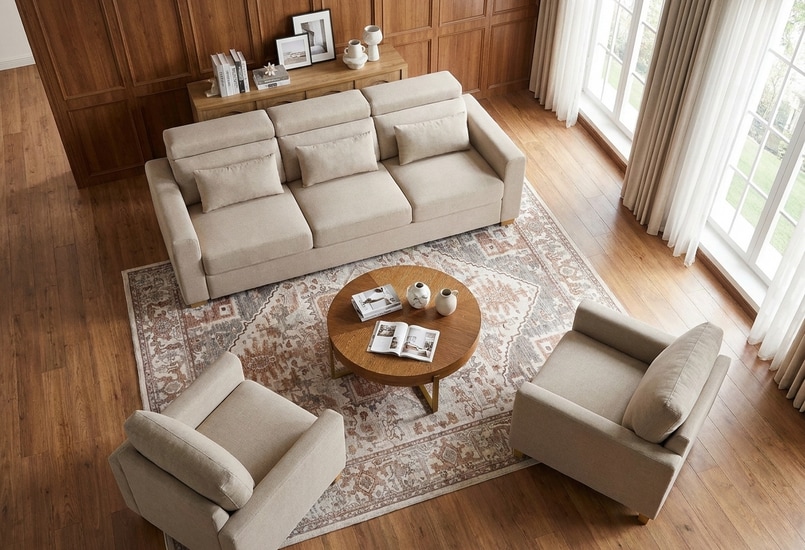
When planning your living room furniture layout, pushing the sofa against the wall often feels like the default choice. It keeps the middle of the room open and leaves more space around the furniture.
But that isn't always the most practical arrangement. In some rooms, pulling the sofa or other large pieces away from the walls can create a more connected seating area, make an open-plan space easier to use, or put an otherwise overlooked area to work.
This approach is often called floating furniture. In this article, the term refers to freestanding pieces positioned away from the walls, not wall-mounted furniture designed to look as if it floats. It can work well in some spaces, but it isn't the right choice for every room.
What Is Floating Furniture?
Floating furniture refers to furniture arranged away from the walls, with open space around at least some of the pieces. Instead of placing every sofa, chair, or table along the room's edges, you bring selected pieces inward to create a more intentional arrangement.
For example, a sofa might sit in the middle of a living room with chairs facing it, forming a seating area. In an open-plan living room, the back of a sofa can also help separate the living area from a dining space without adding a wall or divider.
The idea isn't to move all your furniture away from the walls. It's to position each piece where it best supports how you use the room.
--altImgStart--{"link":"https://s3.springbeetle.com/prod-us2-bucket/living-room-floating-furniture-layout-example_20261104_oJpWfrr8.png","alt":"A modern living room showing a floating furniture layout with the sofa pulled away from the wall."}--altImgEnd--
Why Pulling Furniture Away From the Wall Can Work
Moving furniture inward can change how a room functions. It can bring seating closer together, help distinguish different activity areas, or create a useful space where there was previously none.
Floating furniture tends to work best when moving a major piece improves the seating arrangement or defines a separate area, while still leaving enough room to move around comfortably. Here are a few situations where this arrangement can be worth trying.
Create a More Connected Seating Area
When a sofa and chairs are placed against different walls, people sitting in them may end up farther apart than they need to be. Conversations can feel less natural when everyone has to turn or raise their voice to speak to someone across the room.
Pulling the seating closer together can make the arrangement feel more connected. A sofa and two chairs, for example, can face one another around a coffee table, creating a natural place to talk, read, or spend time together.
The goal isn't to fill the center of the room with furniture. It's to bring the pieces into a comfortable relationship with one another while leaving enough room to walk around them.
--altImgStart--{"link":"https://s3.springbeetle.com/prod-us2-bucket/floating-furniture-connected-seating-area_20261104_lQ6a6Arh.png","alt":"floating-furniture-connected-seating-area.png"}--altImgEnd--
Define Areas in an Open-Plan Room
In an open-plan living room, there may be no walls separating the living area from the dining area or kitchen. Without a clear arrangement, the whole space can feel like one large, undefined room.
A sofa placed with its back toward the dining area can help establish a visual boundary between the two spaces. The living room feels more distinct, while the room remains open and connected.
A rug, coffee table, or pair of chairs can reinforce that arrangement. Just make sure the space behind the sofa still allows people to pass through comfortably, especially if it forms part of the main route between rooms.
--altImgStart--{"link":"https://s3.springbeetle.com/prod-us2-bucket/living-room-floating-furniture-layout-example_20261104_L3GJuGLI.png","alt":" A modern living room showing a floating furniture layout with the sofa pulled away from the wall."}--altImgEnd--
Consider the Space Behind a Sofa
Moving a sofa away from the wall creates space behind it. Depending on the room's size, that area may be useful rather than simply left empty.
A slim console table can provide a place for a lamp, books, or everyday items. A floor lamp can add lighting to the seating area without taking up space beside the sofa. In a larger room, the area might also serve as a walkway.
However, adding furniture behind a sofa only makes sense if there is enough clearance. If the gap is too narrow to use comfortably, a console table or other piece may make the room feel more crowded instead of more functional.
When Floating Furniture Doesn't Make Sense
Moving furniture away from the walls isn't automatically an improvement. In some rooms, it takes up space that would be better left open or makes everyday movement less convenient.
When There Isn't Enough Room to Move Around
A floating layout needs enough space around the furniture. If pulling a sofa inward leaves only a narrow passage between the sofa and the wall, the arrangement may become frustrating to use.
As a general rule of thumb, main walkways work best with roughly 30 to 36 inches of clear width, though the exact clearance depends on the room and the people using it. If the space between the sofa and the nearest wall or furniture falls well below that range, the layout may feel tight even if it looks balanced in a photo.
This is especially important in small living rooms. Keeping larger pieces against the wall can sometimes preserve more usable floor space and leave a clearer route through the room.
The deciding factor isn't simply the room's size. It's whether people can walk around the furniture comfortably without having to squeeze past corners or move other items out of the way.
When Doors, Windows, or Other Access Points Would Be Blocked
Furniture should not interfere with the parts of a room you need to reach and use. A floating arrangement may create problems if it blocks a doorway, makes a window difficult to open, or gets in the way of a frequently used route.
Before moving a sofa or cabinet, consider how people enter the room, where they walk, and which doors, windows, and storage areas need to remain accessible.
If moving a piece creates an obstacle, keeping it against the wall may be the more practical choice.
Floating Furniture vs. Placing Furniture Against the Wall
Neither arrangement is better in every situation. The right choice depends on the room's dimensions, the furniture you have, and how you use the space. You can also combine the two approaches, moving some pieces away from the walls while keeping others along the perimeter.
| Arrangement | When It Works Well | What to Consider |
| Floating furniture | There is enough room to move around the furniture, and moving it helps create a more connected seating area or define separate zones. | Leaves less open floor space, so comfortable clearance around the furniture becomes essential. |
| Furniture against the wall | The room is compact, or keeping larger pieces along the perimeter leaves more usable space and clearer walkways. | Can make seating feel spread out or leave the center of a large room underused. |
| A combination of both | One or two major pieces are positioned away from the walls while other furniture stays along the perimeter. | The arrangement still needs clear walkways and enough space between pieces. |
How to Try Floating Furniture
You don't need to rearrange the entire room at once. Start with one major piece and see whether moving it makes the space more comfortable to use.
Start With One Major Piece
The sofa is often a good place to start because it has a strong influence on the living room layout. Try pulling it slightly away from the wall or turning it to face another seating piece.
Before moving anything else, look at what the new position changes. Does it bring the seating closer together? Does it help separate the living area from another part of the room? Is the space behind the sofa useful?
If moving the sofa doesn't improve the arrangement, there may be no reason to keep it away from the wall.
Check Circulation and Everyday Use
Once the furniture is in its new position, walk through the room as you normally would. Check whether you can pass between the sofa and other furniture without turning sideways or squeezing through a narrow gap. If you find yourself adjusting your path every time you cross the room, the clearance is probably too tight for daily use.
Also consider everyday activities. Can you sit down and get up comfortably? Can you reach the coffee table? Can you open doors and windows without moving anything?
A layout may look balanced but still feel awkward in daily use. Give yourself time to test it before deciding whether the new furniture placement works.
Frequently Asked Questions
1. What does floating furniture mean?
Floating furniture means arranging furniture away from the walls rather than placing every piece along the room's perimeter. For example, a sofa and chairs can be positioned closer together in the middle of a living room to create a defined seating area.
2. Is floating furniture a good idea for a small living room?
It can work in some small living rooms, but it depends on the available space. Moving a sofa away from the wall may improve the seating arrangement, but it can also reduce walking space. If the new layout makes it difficult to move around, keeping the sofa against the wall may be more practical.
3. Can floating furniture make a room look bigger?
Not necessarily. Pulling furniture away from the walls can make a room feel more organized or create clearer activity areas, but it also uses floor space. In a small room, a floating layout may make the space feel more crowded if there isn't enough clearance around the furniture.
4. What furniture works best in a floating layout?
Sofas and armchairs are common choices because their positions help define a seating area. A sofa can also separate a living area from a dining space in an open-plan room. Console tables and floor lamps may work behind a floating sofa if there is enough room to use them without blocking a walkway.
About the Author
The FlexiSpot Content Team covers home office ergonomics, furniture design, and practical ways to make everyday living spaces more comfortable and functional.