
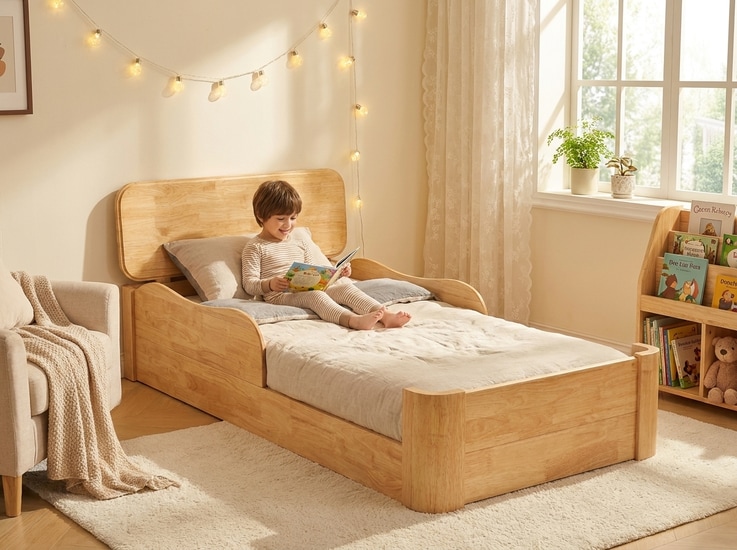
Parents often ask how long a children's bed should last before it needs to be replaced. While buying a kids' bed feels like a long-term investment, many parents are surprised by how quickly their children outgrow them. In many cases, the bed frame itself remains in excellent condition, but it no longer fits the child's rapidly changing size, sleep habits, or daily routine.
According to the American Academy of Pediatrics (AAP), children should transition to a toddler bed once they reach approximately 35 inches in height. They become capable of climbing out of a crib at that stage.
While this transition typically occurs between ages 2 and 3, the AAP emphasizes that physical readiness matters far more than age alone. Understanding these development milestones can help families plan ahead, avoid unnecessary purchases, and choose furniture that remains practical for years to come.
--altImgStart--{"link":"https://s3.springbeetle.com/prod-us2-bucket/kids-bed-lifespan-aap-milestones_20260710_BXf7V1YD.png","alt":"Infographic showing American Academy of Pediatrics height milestones for transitioning from crib to toddler bed."}--altImgEnd--
How Long Does a Kids Bed Usually Last?
Quick answer: A well-built kids bed frame can last for 10 years or more. However, many children outgrow their sleep setups long before the frame itself wears out. For most families, mattress size, bed configuration, and a child's developmental stage determine when it's time for a replacement, rather than structural wear.
Structural Lifespan vs. Functional Lifespan
The lifespan of a children's bed comes down to two different factors. The first is structural durability. A well-built solid wood frame often remains structurally sound even after a child has outgrown it. The second is functional lifespan, which is defined by whether the bed still provides enough space and suits the child's daily routine.
For many households, the limiting factor is rarely wear and tear. Instead, it is the natural growth of the child that renders a standard single-stage bed obsolete earlier than expected.
Five Signs It's Time to Replace a Kids Bed
--altImgStart--{"link":"https://s3.springbeetle.com/prod-us2-bucket/child-outgrowing-twin-mattress-signs_20260710_PM9t7sev.png","alt":"A school-aged child sleeping diagonally on a cramped twin mattress with feet touching the edge."}--altImgEnd--
1. Your Child Has Outgrown the Mattress
One of the clearest signs is that your child no longer fits comfortably. Feet reaching the end of the mattress, sleeping diagonally, or constantly curling up all indicate that additional sleeping space is needed.
When a child sleeps with their knees bent or repeatedly shifts positions, they are often trying to compensate for a mattress that lacks sufficient length. This pattern becomes increasingly noticeable as children grow through elementary school.
2. The Safety Rails Are No Longer Appropriate
Safety rails provide essential reassurance and security for toddlers transitioning from a crib. However, as children become older and more independent, those same rails can become restrictive or unnecessary.
Many modern children's beds feature removable guardrails, allowing the bed to transform instead of requiring a whole new frame. This adaptability is why convertible designs are growing rapidly in popularity.
3. Your Child Desires Independence (When to Move to a Toddler Floor Bed)
As mobility improves, many children prefer greater independence in their daily routines. Some families choose a low-profile floor bed design, often referred to as a toddler floor bed.
This allows young children to get in and out safely and independently. While beds that sit very close to the floor promote autonomy, standard traditional frames that feel too high or too confined may no longer match the child's growth.
4. The Bedroom Needs Have Changed
A child's bedroom eventually evolves into a multi-functional space. Schoolwork, reading, hobbies, and storage gradually become more important. When the room's purpose changes, families often look for furniture that maximizes space.
A bulky frame that worked well for a toddler might feel restrictive in a school-aged child's room where floor space for playtime or a study desk is at a premium.
5. The Bed No Longer Fits Your Long-Term Plans
Sometimes the bed itself is perfectly functional, but the more useful question is whether it will still meet your child's needs two or three years down the road.
If another replacement already seems inevitable in the near future, it is worth considering an adaptable sleep system designed for a longer period of use.
A Longer-Lasting Option: Floor Beds and Convertible Designs
Instead of buying a bed that fits only one fleeting stage of childhood, many modern parents are opting for adaptable designs that grow alongside their children.
A toddler floor bed sits close to the ground and typically accommodates a standard twin or twin XL mattress. This low-profile design drastically reduces fall risks and allows children to navigate their sleep space independently from an early age.
It aligns with Montessori freedom-of-movement principles. And because it uses a standard twin or twin XL mattress, you won't need to buy special "toddler-sized" sheets that will soon become useless. Standard bedding works from day one.
High-quality floor beds are built to support standard twin or twin XL mattresses right from the start, allowing families to keep the same foundation for years. Many of these innovative systems include safety rails that can be detached effortlessly in minutes without digging into your toolbox. As your toddler grows into an independent youth, the rails can be cleanly removed, transforming the frame into a sleek, standard bed for older children and teenagers.
For households looking to curb future furniture expenses, choosing a highly adaptable convertible design provides the ultimate long-term flexibility. It eliminates the need to buy multiple beds across different childhood milestones.
Is It the Mattress or the Bed Frame?
Parents sometimes assume the entire bed setup needs replacing at once, but the mattress and the frame actually have different lifespans. A cheap mattress may lose its support and comfort long before a solid frame wears out.
Conversely, a sturdy wood frame may remain pristine even when your child requires a larger mattress size. Replacing only the component that is lacking is a highly effective way to reduce costs.
Features That Help a Kids Bed Last Longer
When evaluating the long-term ROI of a children's bed, look past surface aesthetics and focus on these core specifications:
| Feature | Why It Matters |
| Solid wood construction | Supports years of active daily use with lasting durability |
| Standard twin or twin XL compatibility | Extends the usable lifespan into the teenage years |
| Removable safety rails (tool-free design) | Seamlessly adapts to different stages of childhood growth |
| Wooden slat support system | Promotes excellent airflow beneath the mattress and reduces moisture buildup |
| Low-to-the-ground floor design | Minimizes fall risks, encourages toddler autonomy, and aligns with Montessori principles |
| Child-safe materials & low-VOC finishes | Ensures a healthier indoor sleep environment and meets strict safety standards |
A Long-Term Approach
Rather than asking how long a specific bed will last, the smarter question to ask is: Can this bed adapt as my child's needs change?
By shifting the focus from single-stage furniture to long-term adaptability, families can significantly reduce their consumption and save money. Choosing frames that accommodate standard twin XL mattresses and feature modular rails makes this possible. This ensures children always have a safe, developmentally appropriate place to sleep.
--altImgStart--{"link":"https://s3.springbeetle.com/prod-us2-bucket/convertible-montessori-floor-bed-twin-xl_20260710_Rw2eATnH.png","alt":"Convertible Montessori Floor Bed that transforms into a Twin XL bed for growing kids."}--altImgEnd--
Frequently Asked Questions
1. How long does a kids bed usually last?
A well-built bed frame can easily last for 10 or more years. However, many children's beds are replaced much earlier simply because the design or mattress size no longer accommodates the child's physical growth.
2. What age should a child stop using a toddler bed?
Most children transition out of a dedicated toddler bed between the ages of 4 and 6. However, the ideal timing depends more on their height, comfort, and sleep habits than their age. If your child looks cramped, it's time to upgrade.
3. What is a toddler floor bed?
A toddler floor bed is a low-profile sleep setup that sits directly on or very close to the floor. It promotes independence by letting young children enter and exit easily. Models that fit standard twin mattresses can be used well into late childhood.
4. When should a child move to a bigger bed?
A larger bed becomes necessary when a child consistently hits the edges of their current mattress, sleeps diagonally to fit, outgrows the weight limits, or no longer requires protective safety guardrails.
5. Can a kids bed last into the teenage years?
Yes, provided it is a convertible or standard frame built around a standard twin or twin XL mattress. Beds built specifically around crib-sized mattresses will generally be outgrown by age 5 or 6.
6. Is it better to replace the mattress or the whole bed?
Not always. If the current frame remains structurally sound, sturdy, and is compatible with the upgraded mattress size you want, you can save money by replacing only the mattress.
7. Are floor beds safe for young children?
Yes. When designed with proper under-bed ventilation (like a slat system) and secure safety rails, floor beds are incredibly safe for toddlers. They completely eliminate the danger of high-altitude falls.
About the Author
Sarah Jenkins is a Child Ergonomics & Sleep Space Researcher at FlexiSpot, where she studies how children's sleep environments affect development, independence, and long-term comfort. Her work focuses on the intersection of pediatric occupational therapy principles and furniture design, with a particular interest in adaptable sleep solutions for growing families.
References
- American Academy of Pediatrics. Make Baby's Room Safe: Parent Checklist. HealthyChildren.org, 2020. Available at: https://www.healthychildren.org/English/safety-prevention/at-home/Pages/Make-Babys-Room-Safe.aspx