
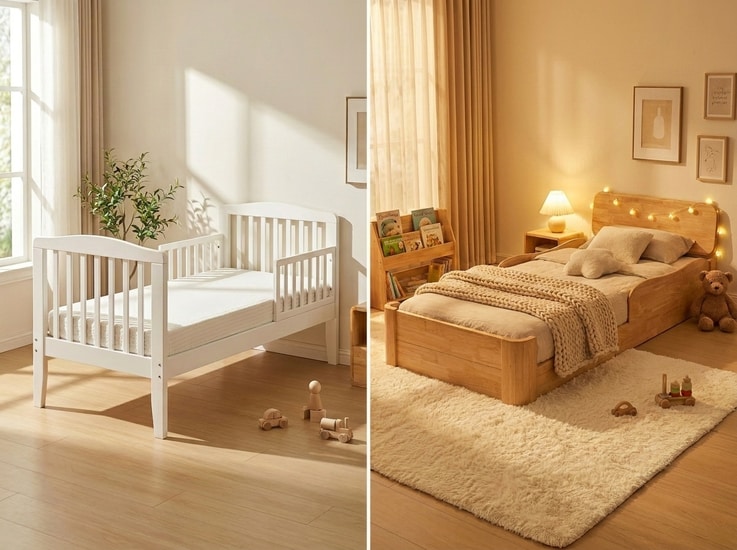
When your child outgrows their crib, the default move for most Canadian and American parents is to shop for a standard toddler bed. It looks cute, fits a standard crib mattress, and seems like the logical next step.
But in a real home, the honeymoon phase with a traditional toddler bed often becomes less practical around age 4 or 5.
A child may start hitting their limbs against the rails. Some refuse to sleep in it because it feels restrictive. Other parents find themselves unable to lay next to their child during a tough middle-of-the-night comforting session because the frame is too small and fragile.
Before you invest in a transitional piece of furniture that you may need to replace or store in the garage within a couple of years, it helps to understand the real lifespan of these beds—and why some families are choosing different approaches to children's sleeping arrangements.
There is no single best option for every household, and both bed types are commonly used across North American homes depending on individual needs.
Quick Comparison: Traditional Toddler Bed vs. Low-Profile Floor Bed
| Feature | Traditional Toddler Bed | Floor Bed (Twin XL Size) |
| Ages Typically Used | Often used for children from ages 2 to approximately 4 years old | Designed for children from toddler age and up |
| Mattress Compatibility | Crib Mattress (27" × 52") | Standard Twin XL Mattress (38" × 80") |
| Typical Lifespan | Often 18–24 months before child outgrows it | Can potentially support longer use depending on design |
| Fall Height | Raised frame, moderate fall risk | Low to the ground, generally associated with lower fall height risk |
| Caregiver Access | Limited; weight capacity often low | Can often accommodate a caregiver temporarily when needed |
Toddler Bed vs Floor Bed: Which One Lasts Longer?
One of the main differences between these two bed types is how long they remain useful as a child grows.
A traditional toddler bed is built around a crib-sized mattress, which typically becomes less practical once a child reaches age 4 or 5. At that point, many families may find themselves shopping for a larger bed.
--altImgStart--{"link":"https://s3.springbeetle.top/prod-common-bucket/commodity/item/1028_file_toddler-bed-size-limitation-vs-twin_20260626_ZeeGhufn.png","alt":"Comparing a standard small toddler mattress with a spacious kids twin bed mattress"}--altImgEnd--
A floor bed designed around a standard twin XL mattress, on the other hand, can potentially be used across multiple growth stages depending on the frame design. This means families may be able to avoid a mid-childhood bed replacement.
Neither approach is inherently better. The choice often comes down to how long you expect the bed to remain in use and whether you prefer a short-term transitional option or a longer-term setup.
How Parents Typically Choose Between Bed Types
In practice, families choose between traditional toddler beds and floor bed designs based on a combination of room size, budget, and how long they expect the furniture to remain in use. Neither option is universally better, and both are commonly used in North American households.
Some families prefer the familiarity and low initial cost of a traditional toddler bed. Others are drawn to floor beds for their adaptability and longer potential lifespan. The choice often depends on sleeping habits, available space, and whether the family plans to transition to a larger bed in the near future.
Understanding the trade-offs between these approaches can help make the decision more straightforward.
--altImgStart--{"link":"https://s3.springbeetle.top/prod-common-bucket/commodity/item/1028_file_modern-kids-floor-bed-bedroom-ideas_20260626_9Njd40xU.png","alt":"Scandinavian style children bedroom design featuring a low profile wooden toddler floor bed with protective rails."}--altImgEnd--
Are Ages 4 and 5 Too Big to Sleep in a Toddler Bed?
A traditional toddler bed may feel too small for many children around this age.
While a standard toddler bed can technically hold a child up to 50 lbs, the physical dimensions are what limit its longevity. A traditional toddler bed uses a standard crib mattress, which is only about 27 inches wide and 52 inches long.
By the time a child turns 4 or 5, their average height is around 40 to 43 inches. Once you add pillows and a stuffed animal, there is often limited clearance. Active sleepers may frequently hit the wooden frame, which can disrupt sleep.
If you buy a traditional toddler bed at age 2, many families may find that it becomes less practical within a few years as their child grows.
The Hidden Costs of the "Crib-to-Toddler-to-Twin" Progression
Many buyers look at the upfront price of a small toddler bed and assume they are saving money. What they may overlook is the extra steps involved in multi-stage furniture transitions:
- The Double Mattress Purchase: A traditional toddler bed requires a crib mattress size. When a child outgrows the bed, families often need to purchase a new twin mattress in addition to a new frame.
- Unused Furniture Storage Issue: Finding a place to sell, donate, or store a used, oddly sized toddler frame can be a logistical challenge.
- Transition Timing: When a child moves to a raised twin bed too early, the change in sleeping height can sometimes affect sleep patterns, leading to late-night parental interventions.
What Is a Floor Bed and How It Differs From Traditional Toddler Beds
To address the limited lifespan of transitional furniture, some families and designers have shifted toward the floor bed concept.
Floor beds are sometimes associated with minimalist or Montessori-inspired bedroom setups, although the design is also widely used in general children's furniture outside of these contexts.
A floor bed places a standard-sized mattress, often a twin XL mattress, on a ventilated slat system directly on or very close to the floor.
Here are some reasons why this design can outlast traditional toddler alternatives:
1. Potential for Longer Use
Because a floor bed can be purchased in a standard twin XL mattress size from day one, the frame may not become obsolete as quickly when a child grows. Depending on the design, it may support use across different growth stages.
Some convertible designs go a step further. Rather than replacing the entire bed as children get older, the same frame can be reconfigured into a standard twin XL bed by removing the safety rails. This allows families to extend the life of the furniture without starting over with a completely new bed.
--altImgStart--{"link":"https://s3.springbeetle.top/prod-common-bucket/commodity/item/1028_file_convertible-montessori-floor-bed-twin-xl_20260626_cH5sZSJU.png","alt":"Convertible Montessori Floor Bed that transforms into a Twin XL bed for growing kids."}--altImgEnd--
2. Lower Fall Height
Traditional toddler beds require safety rails because the bed is elevated 10–15 inches off the ground. A floor bed sits directly on the floor, which means rolling out typically involves only a short distance onto a soft rug. This may reduce fall height compared to elevated bed frames.
3. Space for Caregiver Access
Parents sometimes need to comfort a child during the night due to nightmares, growth pains, or illness. A twin-sized wooden bed frame built flat on the floor provides enough space for a caregiver to sit or lie down temporarily when comforting a child, without the structural concerns of a smaller toddler frame.
What to Look for in a High-Quality Kids Floor Bed
If you want a floor bed that can serve children from the toddler years into adolescence, it helps to focus on structural quality:
- Solid Hardwood Construction: Avoid particleboard (MDF). Active children may jump, lean, and play on the frame. Look for a wooden floor bed made of solid timber for long-term joint stability.
- Removable Safety Rails: For toddlers and young children, floor beds with rails can provide a cozy, dedicated, and defined sleeping environment. However, ensure the front or side rails can be removed later as the child grows into later childhood.
- Internal Slat System: Avoid placing a mattress directly on the bare floorboards or carpet without slats. A proper floor bed frame should include an elevated wood slat base to allow continuous airflow underneath the mattress, preventing moisture retention and mold buildup.
--altImgStart--{"link":"https://s3.springbeetle.top/prod-common-bucket/commodity/item/1028_file_floor-bed-ventilated-slats-detail_20260626_yHlR4rFA.png","alt":"Close-up shot of a solid wood floor bed frame internal wooden slat support system showing the airflow ventilation gap."}--altImgEnd--
Final Thoughts
The question shouldn't just be "How long does a toddler bed last?" The better question is "How many times do I want to rebuild my child's bedroom?"
In North America, both traditional toddler beds and floor bed designs are commonly used, and the choice often depends on family preferences, room layout, and how long parents expect the furniture to remain in use.
While traditional toddler beds offer a brief, cute transition, they often become less practical by age 4. Investing in a robust, adaptable twin bed designed as a low-profile floor bed may support use across different growth stages depending on design, while potentially helping reduce the need for a new bed purchase in the coming years.
Ultimately, the best children's furniture is the kind that doesn't require a replacement plan.
Frequently Asked Questions
1. What is the difference between a cot bed and a toddler bed?
A cot bed is a multi-functional item featuring removable sides that converts into a small bed using the same mattress size. A toddler bed is a dedicated, small-footprint low frame purchased separately after a child outgrows a standard crib. Both share the same limitation: they utilize small crib-sized mattresses that children often outgrow by age 4 or 5.
2. What size is a standard toddler bed mattress?
A standard toddler mattress measures roughly 27 inches by 52 inches, the same size as an American or Canadian standard crib mattress. For long-term utility, some families skip this size and move straight to a standard twin XL mattress (38 inches by 80 inches) configured as a floor bed for older children.
3. Is a toddler house bed good for a child's development?
Low-profile floor beds and house beds are often chosen because they allow toddlers and young children who can already walk to enter and exit their beds independently. Many parents find that this autonomy supports bedtime cooperation and reduces the anxiety associated with climbing out of high beds.
4. How does a floor bed compare to a traditional toddler bed in terms of safety?
A traditional toddler bed is raised off the ground and typically requires safety rails to help reduce the risk of falls. A floor bed sits directly on or very close to the floor, which means falling out generally involves only a shorter distance. Both designs have their own safety considerations, and the best choice depends on the child's developmental needs, room layout, sleeping habits, and the manufacturer's recommendations.
5. What should I look for in a floor bed for long-term use?
Key features include solid wood construction, standard twin mattress compatibility, removable safety rails, and a proper slat support system for ventilation. These features can help extend the bed's usability as a child grows.