
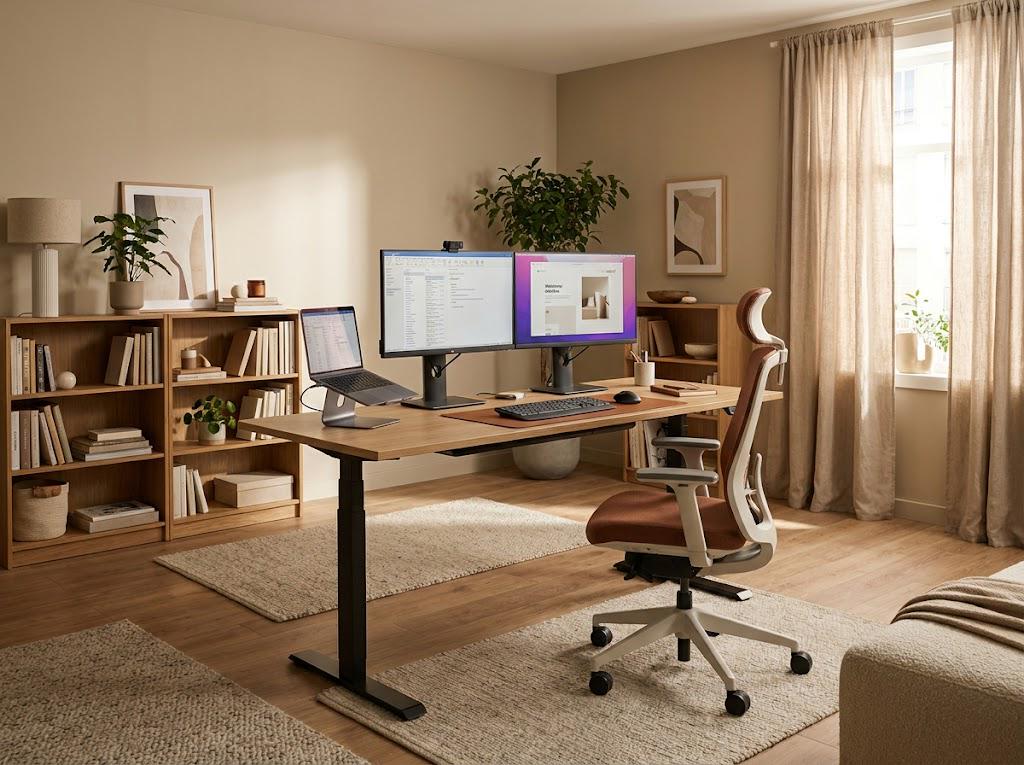
You finish work feeling strangely tired. Not physically exhausted. More like mentally “stuck.” That heavy 2 PM feeling. The constant urge to stretch. Opening random tabs without even realizing why.
A lot of people blame screens. Or burnout. Or remote work itself. But the problem is simpler than that: your body never changed states.
That’s why standing desks quietly became such a defining part of modern home office culture. Not because most people are trying to stand for eight hours straight. Most don’t. The appeal is movement. Variation. The ability to stop feeling frozen at your desk.
If you’ve been asking yourself, “Are standing desks worth it?” or “Is a standing desk good for you?”, the answer usually isn’t in the calories burned. It’s in the rhythm of your workday. And once you notice the difference, it becomes surprisingly hard to go back.
The Problem Was Never Just Sitting
For years, the internet framed the debate like this: is standing at a desk better than sitting?
But that question misses something important.
Most bodies can tolerate sitting surprisingly well. Standing too. What tends to wear people down is the lack of variation.
That’s why working from home changed how many people feel physically, even if their workload stayed the same. In a traditional office, movement happens naturally. Walking to meetings. Talking to coworkers. Leaving for lunch. Even small interruptions help reset the body.
At home, those transitions disappear. People sit longer without noticing. Hours pass in almost identical positions. The body stays static, even while the brain keeps working.
That’s why many people searching “is a standing desk good for you” are often describing something deeper than back pain. They’re describing stagnation. Interestingly, most people who genuinely like standing desks don’t spend all day standing. They just stop staying still.
What a Standing Desk Actually Changes
A good standing desk doesn’t magically make someone healthier overnight. What it often changes first is the feeling of work.
Emails feel easier sitting down. Calls somehow feel shorter while standing. Quick tasks stop turning into 40-minute distractions. The desk becomes less of a surface and more of a behavioral cue.
A surprising number of remote workers end up using desk height almost like lighting or music. --altImgStart--{"link":"https://s3.springbeetle.top/prod-common-bucket/commodity/item/1028_file_standing-desk-sitting-vs-standing-tasks-guide.png_20260515_zEnD4TmM.png","alt":"Comparison chart of tasks for sitting vs standing modes at a height adjustable desk including meetings, writing, and brainstorming."}--altImgEnd-- --altImgStart--{"link":"https://s3.springbeetle.top/prod-common-bucket/commodity/item/1028_file_imagesinfographic-sitting-vs-standing-work-modes.png_20260515_2cKrKv20.png","alt":"Infographic of sitting vs standing work modes for productivity"}--altImgEnd--
This is also why the best standing desk for a home office usually isn’t the cheapest one. If changing positions feels annoying, noisy, or unstable, people stop using the feature altogether. The desk becomes permanently stuck at one height. At that point, it’s just an expensive regular desk.
The best setups make movement feel easy enough that people actually keep doing it.
The Mistake Most New Standing Desk Owners Make
Ironically, many people buy a standing desk and immediately use it the wrong way. Usually with good intentions.
They try to stand for hours straight. Then their feet hurt. Their legs feel tired. Their lower back tightens up. A week later, the desk barely moves anymore.
The healthiest setup isn’t “all standing.” It’s movement between modes.
A 2026 study published in Applied Ergonomics found that workers who alternated between 30 minutes of sitting and 15 minutes of standing reported improvements in lower back pain, concentration, and work-related stress over time.
If you’ve been wondering: how long should you stand at a standing desk?
A good starting point is surprisingly modest. Try standing for about 15 to 30 minutes every hour. Some people prefer a 2:1 sitting-to-standing ratio. Others simply change positions whenever they feel focus slipping.
Most people don’t need to stand longer. They just need more interruptions to stillness.
Research also suggests that standing longer than 40 minutes without a break can start to increase lower back discomfort. So even short movement breaks matter more than marathon standing sessions.
How High Should a Standing Desk Be?
This is where many home office setups quietly go wrong.
People often raise the desk too high because standing feels like it should mean lifting everything upward. But shoulders creeping upward all day creates tension faster than most people realize.
A better guideline is much simpler: relax your shoulders. Keep your elbows close to your sides. Your forearms should rest naturally around a right angle while typing.
--altImgStart--{"link":"https://s3.springbeetle.top/prod-common-bucket/commodity/item/1028_file_standing-desk-ergonomics-height-guide.png_20260515_2JG5J3Ye.png","alt":"Diagram showing correct standing desk height: 90-degree elbow angle and eyes at the top of the monitor."}--altImgEnd--
That’s why adjustable range matters so much when people ask:
- How high should a standing desk be?
- How tall should a standing desk be?
The answer depends on your body, your chair height, your shoes, and even your monitor setup. --altImgStart--{"link":"https://s3.springbeetle.top/prod-common-bucket/commodity/item/1028_file_imagesstanding-desk-height-chart-by-user-stature.png_20260515_7UDFAnML.png","alt":"Ergonomic standing desk height chart showing ideal desk heights for users from 5'2\" to over 6'4\"."}--altImgEnd--
These ranges are only starting points. Arm length, keyboard thickness, footwear, and monitor setup can all slightly change your ideal desk height.
These aren’t strict rules. Just starting points. The best setups usually feel neutral, not dramatic.
Why Stability Matters More Than Most Buyers Expect
This is one of the least discussed differences between cheap and premium standing desks.
At sitting height, almost any desk feels stable enough. At standing height, everything changes. Dual monitors amplify wobble. Typing vibrations become noticeable. Even leaning your wrists against the edge can create movement on weaker frames.
--altImgStart--{"link":"https://s3.springbeetle.top/prod-common-bucket/commodity/item/1028_file_premium-standing-desk-desktop-detail.jpg_20260515_x1sNWRtz.png","alt":"Minimalist standing desk setup with wood desktop and height control panel"}--altImgEnd--
And once people notice instability, they become oddly sensitive to it.
That’s why shoppers searching “what standing desk is best for working from home” often end up prioritizing stability more than aesthetics, especially for people using:
- Ultrawide monitors
- Heavy desktop setups
- Monitor arms
- Dual-screen workstations
This is also where dual-motor systems tend to stand out. Not because they feel flashy, but because smoother adjustments make people more likely to actually change positions throughout the day.
Some desks became popular for exactly this reason. The experience feels calm. Quiet. Predictable.
And with home offices now blending into bedrooms and living spaces, that stability and aesthetic matter more than they used to. It’s no longer just about a single piece of furniture, but about building a premium executive sit-stand workspace where the desk and chair work in harmony.
So, Are Standing Desks Worth It?
Probably not for the reasons social media promised.
A standing desk won’t suddenly turn someone into a productivity machine. It won’t erase poor posture overnight. It won’t replace movement, exercise, or rest.
But many people notice something smaller almost immediately: work feels less stagnant.
That’s usually the first shift.
The day gains more transitions. Energy stops crashing as hard in the afternoon. The body feels slightly more awake during long stretches of computer work.
And over time, that subtle difference becomes part of how people want their workspace to feel. Not rigid. Not frozen. Not trapped in one position from morning to evening.
Just a little less static.
That’s ultimately what a standing desk is really designed to support.
Frequently Asked Questions
1. Is a standing desk better than sitting?
Neither standing nor sitting is ideal when done for too long. The biggest benefit comes from alternating between positions. Movement matters more than choosing one posture permanently.
2. Is a standing desk good for you?
For many people, yes, especially for reducing prolonged static sitting during long workdays. Many users report better energy levels and fewer afternoon fatigue crashes when regularly switching positions.
3. Are standing desks worth it?
They can be, particularly for people working from home full-time. The value usually comes less from “standing” itself and more from improving movement, comfort, and flexibility throughout the day.
4. What is the best standing desk for a home office?
The best desk depends on your setup. For lighter laptop use, simpler models may work. For dual monitors or heavy daily use, stability and motor quality become far more important.
5. How much is a standing desk?
Most quality standing desks range from $400 to $1,200 depending on motor system, frame stability, desktop size, and weight capacity.
6. How long should you stand at a standing desk?
Most people do best alternating throughout the day instead of standing continuously. Around 15 to 30 minutes of standing per hour is a common starting point. Standing longer than 40 minutes without a break can start to increase discomfort.
Final Thought
Sometimes the problem with a workspace isn’t obvious. The chair works. The desk works. Yet by late afternoon, something still feels off.
For many people, that feeling has less to do with productivity and more to do with stillness.
A standing desk doesn’t completely solve modern work fatigue. But it does reintroduce something remote work quietly removed: the ability to change states throughout the day.
And once that rhythm comes back, work often starts feeling more human again.