
_20260427_OOmOXRC2.jpg)
Some bedrooms feel instantly inviting. Others look perfectly fine, but never quite exhale.
It’s rarely the paint, the rug, or even the lighting. More often, it’s the bed.
Not just the mattress. The frame quietly does more than hold things up. It sets the tone, anchors the room, and shapes how the space feels, visually and emotionally.
An upholstered silhouette tells one story. A well-crafted wood frame tells another. Neither is better. They simply lead the room in different directions.
And that really becomes the question: what story should your bedroom tell?
_20260427_JiXXf7Ln.png "download (11).png")
Two Materials, Two Different Design Languages
A bed is often the largest piece in a room. Naturally, it becomes the anchor.
Materials communicate.
Fabric tends to feel softer, more relaxed, a little more forgiving. Wood, by contrast, brings clarity. It defines the room without overwhelming it.
Designers often call this material language. Before you touch a piece, you’ve already formed an impression of what it might feel like to live with.
So choosing between an upholstered bed and a solid wood bed frame isn’t really about which one is better. It’s about how you want the room to behave.
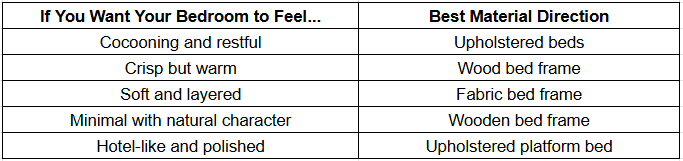
Why Upholstered Beds Change the Feel of a Room So Quickly
_20260427_KGnOJMsW.png "download (12).png")
There’s a reason upholstered silhouettes keep showing up in modern bedrooms.
A fabric bed frame introduces what designers call visual softness. In rooms with hardwood floors, large windows, or minimal detailing, that softness can be quietly transformative. Upholstery diffuses hard lines and lowers contrast, making a space feel more relaxed almost immediately.
It also affects how the room sounds. Fabric naturally absorbs a small amount of ambient noise, which can reduce echo in spaces with lots of hard surfaces. It’s not magic, but it can make a bedroom feel quieter. And quieter often feels calmer.
That’s partly why an upholstered platform bed feels so inviting.
Upholstered Beds Work Especially Well In:
• Rooms with higher ceilings
• Spaces with hardwood or tile flooring
• Minimalist interiors that need warmth
• Bedrooms with abundant natural light, where texture becomes part of the visual experience
A queen upholstered bed frame often appears slightly more substantial than a wood frame of the same dimensions. The padded edges visually expand its silhouette, helping anchor a medium-sized room.
Soft edges. Strong presence.
Why Wood Bed Frames Feel Timeless, Not Trendy
Wood ages unusually well.
A quality wooden bed frame doesn’t simply endure. It evolves. The grain deepens, the tone grows richer, and small marks become part of the story rather than something to hide.
_20260427_RAVuzWMC.png "download (13).png")
That’s especially true of a solid wood bed frame, where natural variation is part of the appeal. No two pieces are exactly alike, and that’s exactly the point.
A well-designed wood platform bed frame is also remarkably versatile. It can feel Scandinavian, Japandi, mid-century, rustic, or contemporary, depending on what surrounds it. Few materials adapt this easily over time.
What Wood Adds That Other Materials Don’t:
• Natural grain variation that creates visual movement
• Long-term durability with proper care
• Structural clarity that helps define a room
• A patina that often improves with age
A king bed frame wood design can serve as a commanding focal point while maintaining a quiet, understated presence.
That’s the beauty of wood. It rarely needs to announce itself.
_20260427_SVmI2ohu.png "download (14).png")
The Overlooked Factor: How Materials Affect Light
Furniture doesn’t just sit in a room. It interacts with light.
An upholstered bed absorbs more light because fabric has a matte surface. That creates a softer, quieter visual effect. Colors appear richer and less reflective, which can make a bedroom feel more intimate, especially in the evening.
Wood behaves differently. Even with a low-sheen finish, its grain naturally catches and reflects light at varying angles. Morning light highlights the grain pattern, while evening light deepens its warmth.
It’s subtle, but meaningful.
• Light-colored wood can help a room feel brighter and more open
• Dark upholstery can create depth and coziness
• Neutral fabrics soften direct sunlight beautifully
• Warm oak or walnut adds richness without visual heaviness
These are the kinds of details people notice instinctively, even if they can’t quite explain why.
Texture Is the Secret to a Layered Bedroom
The most inviting bedrooms rarely rely on a single material.
If everything is hard, a room can feel cold. If everything is soft, it can feel a little undefined.
The best spaces balance contrast.
Upholstered Beds Bring:
• Tactile softness
• Sound absorption
• A sense of comfort
• Gentle visual weight
Wood Beds Bring:
• Structural balance
• Organic warmth
• Natural pattern
• Architectural presence
This is why a room with wood floors and painted walls often benefits from an upholstered bed. Conversely, a bedroom layered with rugs, curtains, and plush bedding may feel more grounded with a wood bed frame.
Good design isn’t about matching everything.
It’s about creating a conversation between materials.
Practical Considerations Most Buying Guides Skip
A beautiful bed should also work beautifully in everyday life.
Choose Upholstery If You:
• Enjoy reading or working in bed
• Want a softer headboard for lounging
• Prefer a cozy, enveloping atmosphere
Choose Wood If You:
• Want simpler maintenance
• Have pets that shed like it’s their full-time job
• Prefer a cleaner, more architectural look
Humidity is another often-overlooked factor. Solid wood naturally expands and contracts with seasonal changes. That’s completely normal. Quality craftsmanship is designed to accommodate that movement. Upholstered frames tend to show fewer visible effects from humidity, though fabric care becomes more important over time.
And if your current bed squeaks every time you roll over, either option will feel like a very welcome upgrade.
Scale and Proportion Matter More Than You Think
The same bed size can feel surprisingly different depending on the material.
An upholstered frame tends to read larger. Its padded perimeter softens the edges and visually expands the silhouette. That makes it especially effective in larger rooms or spaces that need a stronger focal point.
A wood frame often appears lighter and more compact, even when the actual dimensions are nearly identical. That’s a real advantage in smaller bedrooms where visual openness matters.
A Simple Rule of Thumb:
• Smaller rooms often benefit from lighter-toned wood
• Larger rooms can handle the added visual weight of upholstery
• Rooms with limited natural light often feel brighter with wood
• Spacious, airy rooms often become cozier with fabric
It’s less about square footage and more about balance.
Frequently Asked Questions
1. Is an upholstered bed frame better than a wood bed frame?
It depends on your lifestyle and the atmosphere you want to create. An upholstered bed frame usually feels softer, quieter, and more relaxed, while a solid wood bed frame tends to feel cleaner, more structured, and timeless. Both work beautifully in different kinds of bedrooms.
2. Are upholstered beds hard to maintain with pets?
Not necessarily. Many modern upholstered beds use durable performance fabrics that are easier to maintain than people expect. Occasional vacuuming is usually enough for everyday care. If you have heavy-shedding pets or want the simplest upkeep possible, a wood bed frame may still be the easier option.
3. Which is better for a minimalist or Japandi bedroom?
Both can work well, but they create different moods. A wood platform bed frame emphasizes clean lines and natural warmth, which fits naturally into Japandi and Scandinavian interiors. Meanwhile, a platform upholstered bed in a neutral fabric can add "soft minimalism" to a space.
4. Do wood bed frames last longer than upholstered beds?
In many cases, yes. A high-quality solid wood bed frame, especially in hardwoods like oak or walnut, can last for decades with proper care. Upholstered beds can also be very sturdy, though fabric may show wear earlier depending on use and material quality.
5. Are upholstered beds good for people with allergies?
For people with severe dust allergies, a wood bed frame is often the lower-maintenance option because it doesn’t trap fabric particles or dust as easily. That said, many modern upholstered beds use tightly woven fabrics that are easy to clean and maintain with regular care.
6. Does a queen upholstered bed frame make a small bedroom look smaller?
Not always. A queen upholstered bed frame with a lower profile, slimmer rails, and lighter fabric tones can actually help a bedroom feel softer and more balanced without visually overwhelming the space.
So, What Story Should Your Bedroom Tell?
Both have lasting appeal, just for different reasons.
One wraps the room in softness. The other gives it structure.
The right choice isn’t what’s trending. It’s what makes your bedroom feel the way you want to live in it.
Because the best bedrooms don’t just look beautiful. They tell your story.