
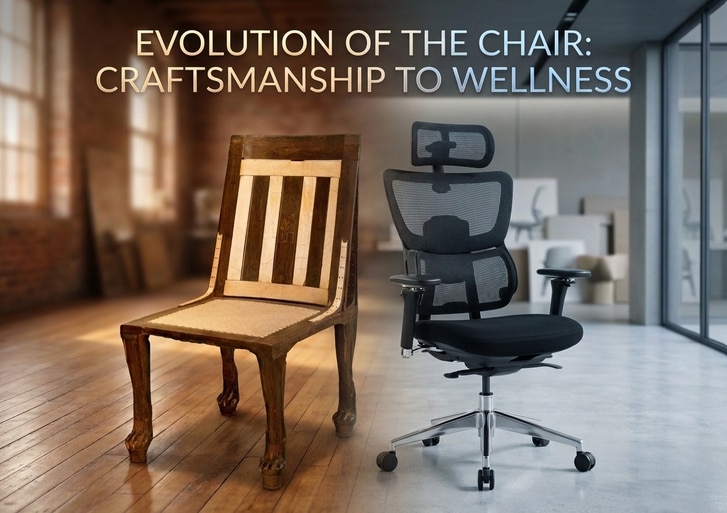
A chair back seems so ordinary that it is easy to overlook. Pull out a dining chair, sit down at a desk, or settle into an armchair, and the backrest is simply part of the design. But not every seat has a back. Stools, benches, and other backless seats have served people for thousands of years.
So why did people begin adding backs to chairs? Was the goal to make sitting more comfortable, or did a chair also communicate something about the person sitting in it? Over time, chair backs took on different forms, from narrow wooden supports to tall, shaped backs designed for particular activities.
The history of the chair back is more complicated than a simple story of comfort improving over time. In many early societies, backed chairs were associated with wealth and rank. Access to backed chairs widened only after changes in production and domestic life, and those changes did not happen everywhere at once. The backrest did not follow one universal path from a marker of status to an everyday design feature. Its role changed across cultures and periods, shaped by the ways people lived, worked, and furnished their homes.
How Did the First Chairs With Backs Develop?
The exact moment when people first added a backrest to a seat is unknown. Early seating was often made from materials that did not survive, and a stool or simple platform could serve many purposes without needing a back.
Ancient Egyptian furniture provides some of the clearest surviving evidence for early backed seating. Stools were common, while depictions of chairs with backs appear in material associated with Egypt’s Second Dynasty, around 2890 to 2686 BCE.
In its simplest form, a backrest adds an upright support behind the seat. This gives the sitter something to lean against, although we cannot know whether the earliest makers described its purpose in those terms. The backrest may have served practical, symbolic, and decorative functions at the same time.
A surviving example makes this clear. The Chair of Reniseneb, dated to around 1450 BCE and held by the Metropolitan Museum of Art, belonged to a scribe. Its back is veneered with ivory and decorated with an incised scene showing the owner seated on a chair of identical form. The museum notes that this is the earliest surviving chair with such a representation and the only non-royal example known. The chair’s high-quality joinery and proportioned form also demonstrate the skill of Egyptian carpenters.
--altImgStart--{"link":"https://s3.springbeetle.com/prod-us2-bucket/history-of-chair-backrests-chair-of-reniseneb-1450bce_20261026_9wRLxvny.png","alt":"A visual evolution of chair backrests from ancient historical artifacts to modern ergonomic office chairs."}--altImgEnd--
This chair shows that a backed seat could be more than a practical object. Its materials, craftsmanship, and decoration gave it personal and funerary significance, while the image on its back connected the chair to its owner. The backrest was part of a larger object whose meaning extended beyond sitting.
Why Didn’t People Simply Sit on the Floor?
People have always sat on the floor, and many still do. Floor seating can be practical when furniture is scarce, when a room is used for several activities, or when local customs favor sitting on mats, cushions, or low platforms.
Making a wooden chair required materials, tools, labor, and woodworking skills. In some historical societies, elaborate chairs were costly furnishings associated with people of wealth and high rank. In ancient Egypt, surviving evidence shows that stools were common, while elaborate chairs are especially visible in material associated with high-status individuals. This does not mean that ordinary people never used raised seating, but it does show that the surviving record is uneven and favors the furnishings of the elite.
Different ways of sitting suited different environments and customs. A floor mat could be moved or stored easily, while a raised seat could be useful when sitting at a table or occupying a more clearly defined place in a room.
The more useful question is not why people abandoned the floor, but why particular activities and social settings made raised seats worth having. Floor seating and raised seating have coexisted for long periods, and the balance between them has varied by region and period. There was no single moment when everyone stopped sitting on the ground and moved to chairs.
Why Did Backrests Become Associated With Status?
A backrest has an obvious practical use: it gives the sitter something to lean against. Yet making a chair with a back required additional material and work, and early chairs were not equally available to everyone. In ancient Egypt, backed chairs were among the furnishings associated with people of wealth and high rank.
The chair could also become a visible sign of authority. Its materials, craftsmanship, and ornament could communicate wealth, office, or social standing. The backrest was one element in a larger object, not a standalone symbol.
The relationship between seating and hierarchy continued in other historical settings. At the French royal court, seating arrangements followed strict rules. According to the Metropolitan Museum of Art, depending on rank, a person remained standing or was assigned a floor cushion, a stool, or, rarely, a side chair. Armchairs were reserved for the king and queen. This example shows that the social meaning of a seat did not come from the backrest alone. The type of seat, its decoration, where it was placed, and who was permitted to use it all helped communicate status.
--altImgStart--{"link":"https://s3.springbeetle.com/prod-us2-bucket/history-of-chair-backrests-french-royal-court-seating_20261026_9oO14wvr.png","alt":"Ornate historical folding stool representing the strict seating hierarchy and social status at the French royal court."}--altImgEnd--
As chairs became more widely available, their social meaning changed, but seating continued to reflect differences in formality, setting, and access. The backrest was part of that larger story, not the sole symbol of rank.
How Did Chairs Move Into Everyday Life?
The history of the chair is not a straight line from a rare status object to a universal household item. In different places, backed seating entered daily life at different times and through different routes.
In Renaissance Italy, the sgabello illustrates how a backed seat could serve decorative and social purposes as well as provide a place to sit. These chairs were often carved and elaborately ornamented, making their appearance part of their function. According to the Victoria and Albert Museum, in Venice, sgabelli often stood in sets along the walls of the portego, a long room used for family celebrations, display, and hospitality.
A more decisive change came in the nineteenth century, when industrial production made it possible to manufacture and distribute chairs on a larger scale. Michael Thonet’s No. 14 chair, introduced in 1859, used standardized bentwood parts that could be shipped and assembled by retailers. According to the Vitra Design Museum, the parts for thirty-six chairs fit into a single cubic metre crate.
The No. 14 illustrates how standardized production and compact shipping helped manufacturers produce chairs at scale and distribute them more widely. Retailer assembly also reduced the need to ship each chair fully assembled, although the pace and extent of these changes varied by region.
Floor seating remained common in many parts of the world, and the adoption of backed chairs followed different paths across regions.
Why Do Dining, Office, and Lounge Chairs Have Different Backs?
Chair backs have long varied according to how and where a seat was used. As backed chairs became more widely available and furniture production expanded, designers could develop and distribute more specialized forms. A backrest that works well at a dining table may not be the best choice for working at a desk or relaxing in a living room.
Dining Chairs: Support Without Taking Over the Table
Dining chairs are generally designed around a table and the movements involved in eating and conversation. Their backs often allow the sitter to remain relatively upright, and their size needs to work with the table height and the space around it. A tall, heavily reclined back may be unnecessary, and the chair also needs to be practical to pull out and push in.
Office Chairs: Designed for Longer Periods of Sitting
Office chairs are designed for tasks that may involve extended periods of sitting, keyboard and mouse work, and frequent changes in position. Their backs may have a more pronounced shape or adjustable lumbar support.
Lounge Chairs: Room to Lean Back and Relax
Lounge chairs are generally designed for a more relaxed posture. Their backs may be taller, wider, or more reclined, and the seat may be deeper than that of a dining chair. Some include a headrest or extended upper back for additional support when leaning back.
Dining, working, and relaxing place different demands on a seat. Modern chair backs reflect those demands, although specialized seating existed long before industrial production.
From History to Modern Design: How to Choose a Backrest Today
The history of the chair back shows how a single design element can serve comfort, status, and practicality at different points in time. In the modern office, the backrest has taken on a more specific role: supporting the spine through long hours of seated work.
Historical chairs could offer a surface to lean against, but they were not designed around the kind of sustained, repetitive desk work that defines many modern workdays. Today’s ergonomic office chairs address problems that earlier chair makers did not face in the same way, such as lower-back fatigue, changing posture, and the need for support that moves with the body rather than staying fixed.
Modern ergonomic chairs often use features such as dynamic lumbar support, breathable mesh, and adjustable back angles to adapt to different bodies and working styles. These are not decorative additions. They respond to the same question that has shaped chair design for centuries: what does the person sitting in this chair actually need?
If you are choosing a chair for daily work, look beyond the shape of the backrest alone. Consider how the back supports your posture over time, whether the lumbar area can be adjusted, and how the chair feels after an hour, not just a minute. You can explore the ergonomic office chair collection to compare designs built around long-term seated comfort.
--altImgStart--{"link":"https://s3.springbeetle.com/prod-us2-bucket/ergonomic-chair-fitting-checklist_20261026_LjfaSzKd.png","alt":"Checklist for choosing the right ergonomic chair."}--altImgEnd--
Conclusion: A Backrest Is More Than an Extra Piece of Wood
The history of chair backrests shows that a familiar design feature can carry several purposes at once. A backrest can provide a place to lean, contribute to the appearance of a chair, or reflect the setting in which it is used. Its meaning has changed with materials, manufacturing methods, and social customs.
That is why chair backs vary so widely today. Their shape is not simply a measure of how much support a chair provides. It also reflects what the chair is meant to do, where it belongs, and how people use it.
Frequently Asked Questions
1. When were chairs with backs first invented?
The exact date is unknown, but surviving evidence from ancient Egypt includes depictions of chairs with backs associated with the Second Dynasty, around 2890 to 2686 BCE. Other surviving evidence, including elaborate chairs associated with high-status individuals, shows that backed seating could also reflect social standing.
2. What is the difference between a stool and a chair?
A stool usually has a seat without a backrest, while a conventional chair has a back. However, furniture categories overlap, and historical designs do not always fit modern definitions neatly. A sgabello, for example, could have a back and still be described as a stool-like form.
3. Were chairs originally a luxury?
In some ancient societies, including ancient Egypt, chairs were associated with wealth and high social standing. Their materials and construction made them less accessible than simpler forms of seating, such as stools, mats, and floor cushions. This varied across cultures and periods, so chairs were not universally luxury objects throughout history.
4. Did people invent backrests to improve posture?
It is difficult to assign a single original intention to the first backrests. A backrest provides a surface to lean against, but early chair design also reflected materials, craftsmanship, social customs, and the intended use of the furniture. It would be misleading to assume that the earliest chairs were designed according to modern ergonomic principles.
5. Why do office chairs have different backs from dining chairs?
Office chairs are intended for work that may involve longer periods of sitting and repeated changes in position. Dining chairs are designed around a table and the movements involved in eating and conversation. Their backrests reflect those different tasks.
6. What should you look for in a chair back?
Consider how the chair will be used. A backrest that suits a dining table may not suit long working sessions or reclining. Look at the back’s height, shape, and angle relative to the seat, and check whether it supports the way you actually sit. A taller back is not automatically more supportive.
Sources and Further Reading
- Chair of Reniseneb, The Metropolitan Museum of Art
- Folding Stool (Pliant), The Metropolitan Museum of Art
- Chair (Sgabello), Victoria and Albert Museum
- No. 14 / Consumer Chair, Vitra Design Museum
- Geoffrey Killen, *Ancient Egyptian Furniture: Volume I, 4000–1300 BC*. 2nd ed. Oxbow Books, 2017, Chapter 5, “Chairs.”
About the Author
David Vance is an ergonomic design researcher and furniture historian specializing in workplace wellness and the evolution of domestic seating. With a background in industrial design and years of experience analyzing workspace productivity trends, David writes for FlexiSpot to help readers understand how historical furniture mechanics translate into modern ergonomic solutions for healthier, more active workspaces.
When he’s not researching chair mechanisms or testing standing desk setups, you can find him exploring mid-century modern design archives.